
Back to: AMERICAN HISTORY 101: PRE-COLONIAL TO CIVIL WAR
Lesson 25 – The Bill of Rights: Protecting the People from Their Government
| THEME | The Bill of Rights was not simply a gift from the Founders — it was a demand from the people, won by Anti-Federalists and other ratification critics who refused to trust a strong new government without explicit protections for liberty. |
Summary
The first ten amendments to the Constitution — ratified in 1791 — are, for many Americans, the most practically important part of the Constitution in daily life. They protect freedom of speech, press, religion, assembly, and petition; guard against unreasonable searches and seizures; guarantee jury trials and due process of law; and reserve to the states and people powers not granted to the federal government. They were drafted by James Madison in the first Congress, fulfilling promises made during the ratification debates. The Anti-Federalists who demanded explicit protections were right to insist that liberty needed more than structural safeguards. A strong central government could — and at times would — attempt to suppress the freedoms that make self-government possible.
Resolutions drafted by Patrick Henry were the first nail in the coffin of the Stamp Act – and foreshadowed nullification.
Learning Objectives
By the end of this lesson, you should be able to:
- Identify and explain each of the ten amendments in the Bill of Rights.
- Explain how the Bill of Rights was drafted and ratified, and who deserves credit for its existence.
- Describe the First Amendment’s five freedoms and explain why they are foundational to self-government.
- Explain the significance of the Ninth and Tenth Amendments in the structure of American federalism.
- Analyze how the Bill of Rights has been interpreted and applied throughout American history.
Visual Context
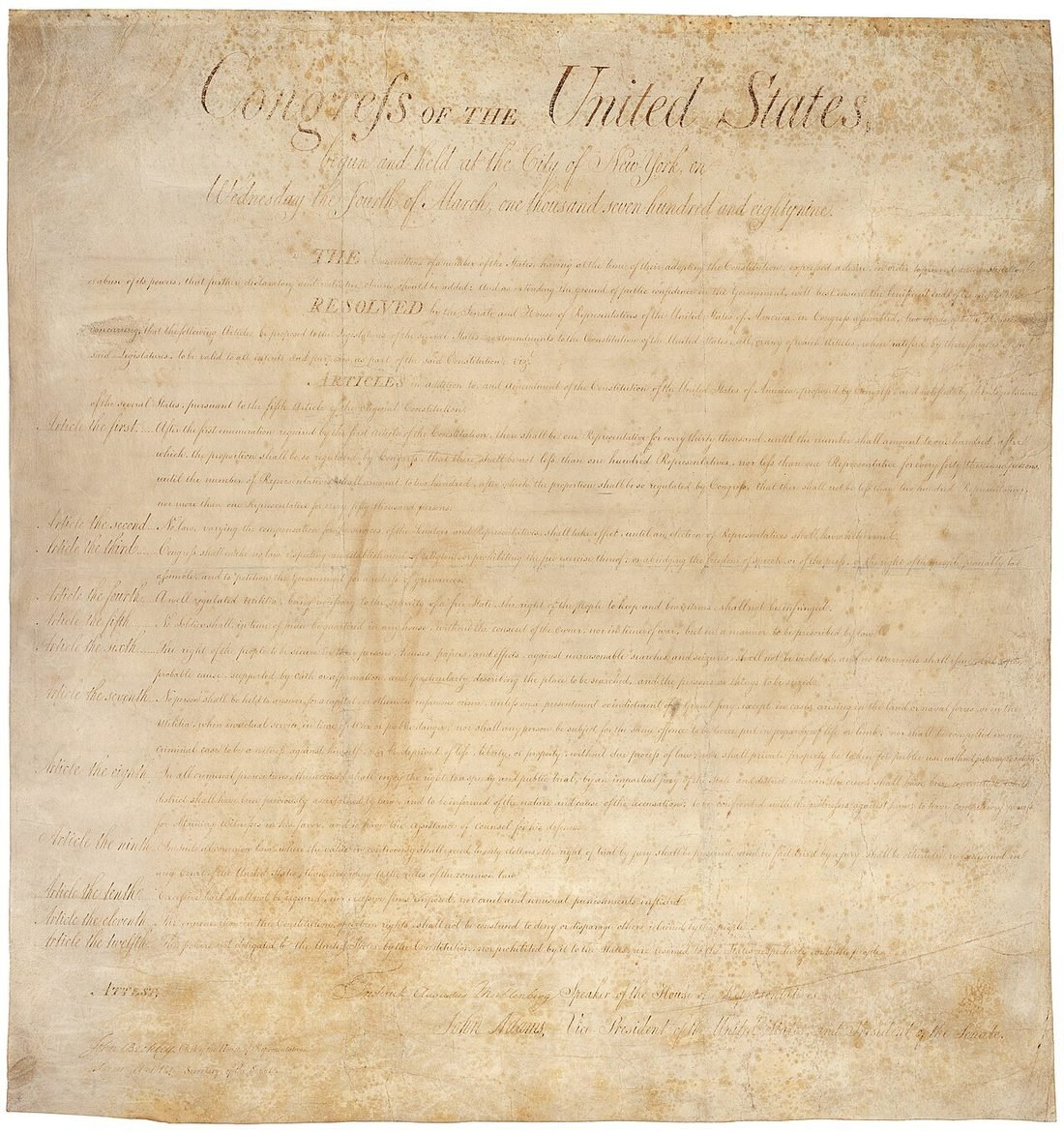
Source: National Archives
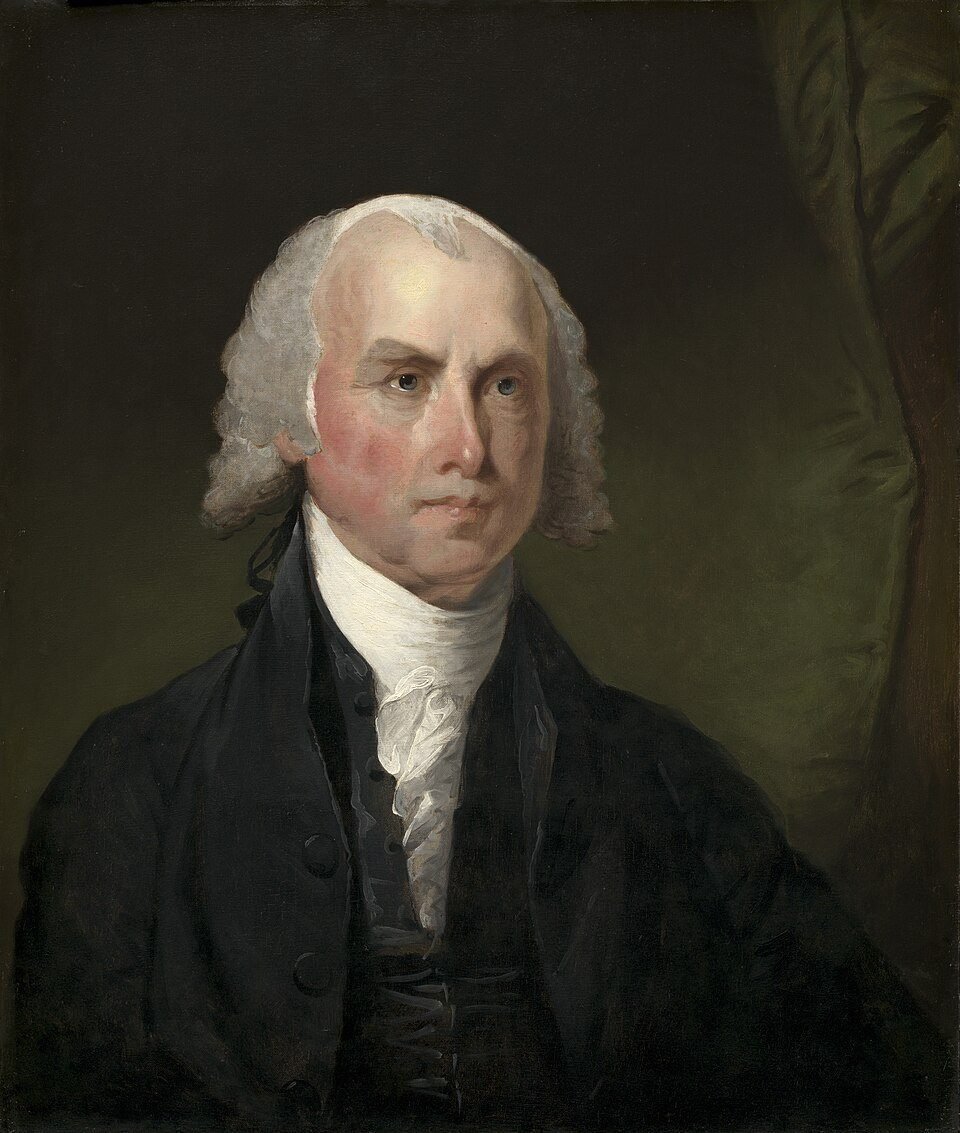
Source: National Gallery of Art
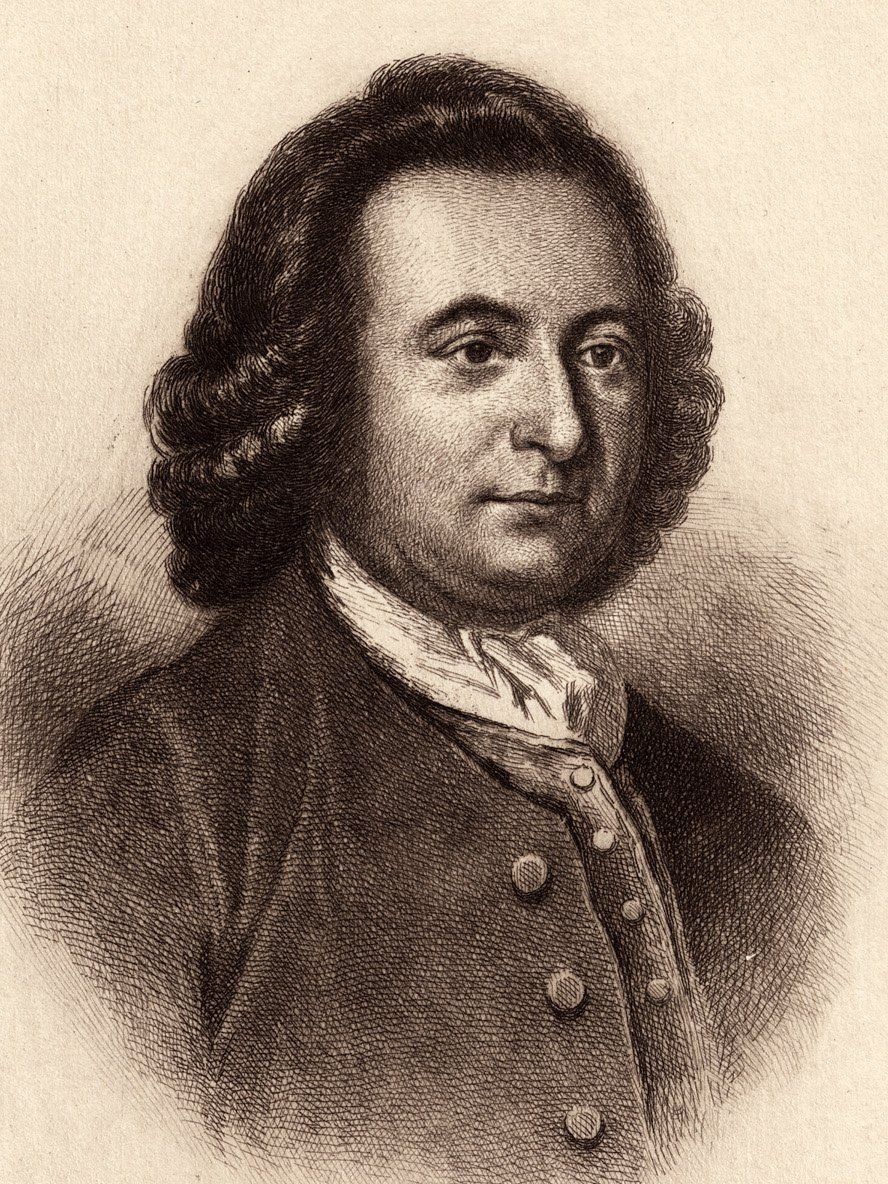
Source: Wikimedia Commons
Key Vocabulary
| Term | Definition |
|---|---|
| Bill of Rights | The first ten amendments to the U.S. Constitution, ratified in 1791, protecting individual liberties from federal government overreach. |
| First Amendment | Protects five freedoms: religion (no establishment; free exercise), speech, press, assembly, and petition of government. |
| Due process | The legal requirement that the government must follow fair procedures before depriving a person of life, liberty, or property. |
| Establishment clause | The First Amendment’s prohibition on Congress making any law ‘respecting an establishment of religion.’ |
| Tenth Amendment | Reserves to the states and to the people all powers not delegated to the federal government by the Constitution. |
Story & Historical Narrative
A. Opening Lead
On June 8, 1789, James Madison stood before the House of Representatives and introduced a set of proposed constitutional amendments. He had not originally believed a bill of rights was necessary. He thought the Constitution’s structure — separated powers, federalism, and limited enumerated authority — would protect liberty. He also worried that listing rights might imply that unlisted rights did not exist. But he had promised his Virginia constituents he would support amendments, and he understood that the new government needed public trust. What Congress refined and the states ratified as ten amendments became, for many Americans, the most familiar and practically important part of the Constitution.
B. What the Bill of Rights Protects
The First Amendment is the cornerstone: Congress shall make no law establishing a religion or prohibiting free exercise; abridging freedom of speech or of the press; or preventing peaceful assembly and petitioning the government. The Second Amendment protects the right to keep and bear arms. The Third prohibits quartering soldiers in private homes. The Fourth protects against unreasonable searches and seizures. The Fifth through Eighth Amendments protect rights of the accused: grand jury indictment, no double jeopardy, no self-incrimination, due process, just compensation for taken property, speedy and public jury trial, confrontation of witnesses, assistance of counsel, no excessive bail, no cruel and unusual punishment. The Ninth says enumerated rights are not exhaustive. The Tenth reserves unenumerated powers to states and people.
C. The First Amendment’s Five Freedoms
The First Amendment protects the five freedoms that make self-government possible. Without freedom of religion, government can use spiritual authority to control citizens. Without freedom of speech and press, citizens cannot criticize their government or share information needed for informed political participation. Without freedom of assembly, citizens cannot organize into political movements. Without the right to petition, citizens have no formal mechanism for demanding government action. These five freedoms are not conveniences — they are the architecture of self-government. Remove any one of them and you have a fundamentally different kind of country.
D. The Bill of Rights as a Restriction on Government Power
One of the most important and least-taught details about the Bill of Rights is the preamble Congress attached to it — a preamble most Americans have never read. The preamble stated that the amendments were added as ‘further declaratory and restrictive clauses.’ In other words, the Bill of Rights was meant to clarify and restrict the powers of the federal government. The amendments are not separate from, or more powerful than, the Constitution; they are part of the Constitution itself. But their purpose is unmistakable: to draw lines the new national government was not supposed to cross.
That framing matters. The Bill of Rights is not a decorative appendix. It is a set of enforceable constitutional limits, written because many Americans did not trust any government — even one created in the name of liberty — to police itself without clear boundaries.
E. Constitutional & Philosophical Issues
Madison’s Ninth Amendment reflects a profound philosophical point: the rights of the people are not limited to what a document lists. ‘The enumeration in the Constitution of certain rights shall not be construed to deny or disparage others retained by the people.’ Madison was worried that listing rights would imply that unlisted rights could be taken away. The Ninth Amendment is the Constitution’s acknowledgment that human dignity and freedom are larger than any list. The Tenth Amendment completes this by reserving all governmental powers not specifically granted to the federal government to the states and people.
“The powers not delegated to the United States by the Constitution, nor prohibited by it to the States, are reserved to the States respectively, or to the people.”
F. Long-Term Historical Impact
The Bill of Rights was largely ignored by federal courts for its first century — held to apply only against the federal government, not states. The Fourteenth Amendment (1868) began the slow process of ‘incorporating’ the Bill of Rights against state governments through the due process clause. This process — still not complete — means most of the Bill of Rights now protects citizens from both federal and state government action. The meaning and reach of the Bill of Rights have been shaped through two centuries of court decisions, legislative struggles, and citizen activism.
| WHY IT MATTERS TODAY | You live under the Bill of Rights every day. The First Amendment protects your ability to practice your religion, read what you choose, say what you think, gather with friends for any peaceful purpose, and sign a petition to your senator. The Fourth Amendment means police generally need a warrant to search your home. The Fifth means you cannot be forced to testify against yourself. These are not abstract legal concepts — they are the practical conditions of living as a free person in a republic. |
Key Takeaways
- The Bill of Rights — the first ten amendments — was ratified in 1791, fulfilling the Anti-Federalists’ demand for explicit protections of individual liberty.
- Madison drafted the amendments in the first Congress, drawing primarily on Virginia’s Declaration of Rights.
- The First Amendment’s five freedoms (religion, speech, press, assembly, petition) are the foundation of self-government.
- The Ninth Amendment reserves unlisted rights to the people; the Tenth reserves ungranted powers to states and people.
- The Bill of Rights originally applied only against the federal government; it has been gradually incorporated against state governments since the 14th Amendment.
Short Writing Assignment
The First Amendment begins: ‘Congress shall make no law…’ In 1–2 paragraphs, explain why each of the First Amendment’s five freedoms is necessary for self-government. What would happen to democratic participation if any one of them were eliminated?
Extended Learning (Optional)
Expanded Writing Assignment
George Mason’s Virginia Declaration of Rights (1776) was the primary model for the federal Bill of Rights. Read both documents. In 4–6 paragraphs, compare the two: What rights appear in both? What does the federal Bill of Rights add? What does Virginia’s Declaration include that the federal version omits? What does this comparison tell us about how constitutional rights develop from state to national level?
Discussion Question
The First Amendment protects speech that many people find offensive, dangerous, or harmful. Should free speech have limits? Who should decide? What are the risks of allowing government to decide which speech is permissible? What are the risks of allowing all speech, even speech that incites violence or spreads dangerous falsehoods?
Primary Source Spotlight
“The enumeration in the Constitution of certain rights shall not be construed to deny or disparage others retained by the people.”
— Ninth Amendment to the U.S. Constitution, ratified December 15, 1791
The Ninth Amendment is the most philosophically significant and least understood provision in the Bill of Rights. Madison included it specifically to address the worry that listing rights might imply that unlisted rights could be taken away. It establishes that the Constitution is not a complete statement of human rights — it is a minimum, not a maximum.
Extension Activity
Research one Supreme Court case involving the First Amendment from the 20th or 21st century (suggestions: Tinker v. Des Moines, 1969; New York Times v. United States, 1971; Citizens United v. FEC, 2010). Write a paragraph describing the case and the Court’s decision. Do you agree with the outcome?
Explore Further
Read the Evidence
U.S. Constitution, Amendments I-X
George Mason, Virginia Declaration of Rights (1776)
Learn More
Akhil Reed Amar, The Bill of Rights: Creation and Reconstruction
Explore
National Archives: Bill of Rights
Liberty Tree University Resources
Videos, readings, and practice activities.
Click a title to open it.
Bill of Rights: Fill in the Blanks
Practice activities — click one to open it:
Bill of Rights 1-5 – Fill in the blanks
Fill in each blank, then click Check answers.
This activity needs JavaScript.
Bill of Rights 6-10 – Fill in the blanks
Fill in each blank, then click Check answers.
This activity needs JavaScript.
Quiz #1 – Bill of Rights
Answer each question, then click Submit quiz.
This activity needs JavaScript.
There Are Vacancies in the House
On September 25, 1789, the Congress of the United States submitted 12 proposed amendments to the eleven states that existed at that time. North Carolina and Rhode Island were not eligible to vote for or against the ratification of these amendments because they had not yet ratified the Constitution.
In order for the proposed amendments to be properly ratified, eight of the eleven states would have been needed. The originally proposed first amendment (the Congressional Apportionment Amendment) was ratified by these states:
- New Jersey: November 20, 1789
- Maryland: December 19, 1789
- South Carolina: January 19, 1790
- New Hampshire: January 25, 1790
- New York: February 24, 1790
- Pennsylvania: September 21, 1791 (after rejecting it on March 10, 1790)
- Virginia: November 3, 1791
Three-fourths of eleven states is 8.25. Thomas Jefferson, who was Secretary of State, and President George Washington both agreed the fraction should be reduced to eight, the nearest whole number.
North Carolina and Rhode Island were allowed to vote on the amendment, which raised the bar from 8 of 11 to 10 of 13. If only the states that existed when the amendment was proposed were allowed to vote on its ratification, the amendment was lawfully ratified.
The legislatures of North Carolina, Rhode Island, Kentucky and Vermont also voted to ratify the originally proposed first amendment after eight states had already ratified it.
According to the 2020 census, the population of the United States is about 332,600,000, and under this amendment the House of Representatives should have one representative for every 50,000 inhabitants.
When vacancies happen in the Representation from any State, the Executive Authority thereof shall issue Writs of Election to fill such Vacancies.
Article I, Section 2, Clause 4
Tenth Amendment Center
Enroll in American History 101
This lesson is free to read. Enroll to unlock all 48 lessons, the quizzes, and your Certificate of Completion.
One Time
Get lifetime access to American History 101: Pre-Colonial to Civil War
for a single one-time payment.
- 48 self-paced lessons spanning pre-colonial America through the Civil War
- A quiz with every lesson, plus a full final exam
- Exclusive “alternative perspectives” on pivotal moments other courses overlook
- Designed for high school, homeschool, and adult education
- Pay once — no subscriptions, no renewals