
Back to: AMERICAN HISTORY 101: PRE-COLONIAL TO CIVIL WAR
UNIT III — Revolution and Founding: 1775–1783
(Lessons 18–23)
Unit III covers the eight years of the American Revolution — from the Declaration of Independence through the triumph at Yorktown and the Treaty of Paris. Students will examine why ordinary Americans fought, how the Continental Army survived repeated crises, what the Declaration meant philosophically, and how a ragged colonial militia defeated the world’s most powerful military empire.
Lesson 18 – The Declaration of Independence: America’s Founding Creed
| THEME | The Declaration of Independence is not just a historical document — it is a promise the nation has been trying to keep ever since. |
Summary
On July 4, 1776, the Second Continental Congress adopted a document drafted primarily by Thomas Jefferson that declared the thirteen colonies to be free and independent states. But the Declaration is far more than a legal severance from Britain. Its second paragraph — asserting that ‘all men are created equal’ and endowed with ‘unalienable rights’ to ‘Life, Liberty, and the pursuit of Happiness’ — is the most important statement of political philosophy in American history. It planted a seed that abolitionists, suffragists, civil rights activists, and ordinary citizens have been invoking ever since to demand that America live up to its own ideals.
We explore Thomas Jefferson’s journey from a Virginia delegate to a Founding Father. A patriot who helped shape America through law, diplomacy, and his visionary leadership.
Learning Objectives
By the end of this lesson, you should be able to:
- Identify the three parts of the Declaration and explain the purpose of each.
- Explain the natural rights philosophy embedded in the Declaration’s preamble.
- Describe Thomas Jefferson’s drafting process and the changes Congress made.
- Analyze why the Declaration excluded women, enslaved people, and indigenous people from its promise of equality.
- Evaluate the Declaration’s long-term significance as both a founding document and an unfulfilled promise.
Visual Context
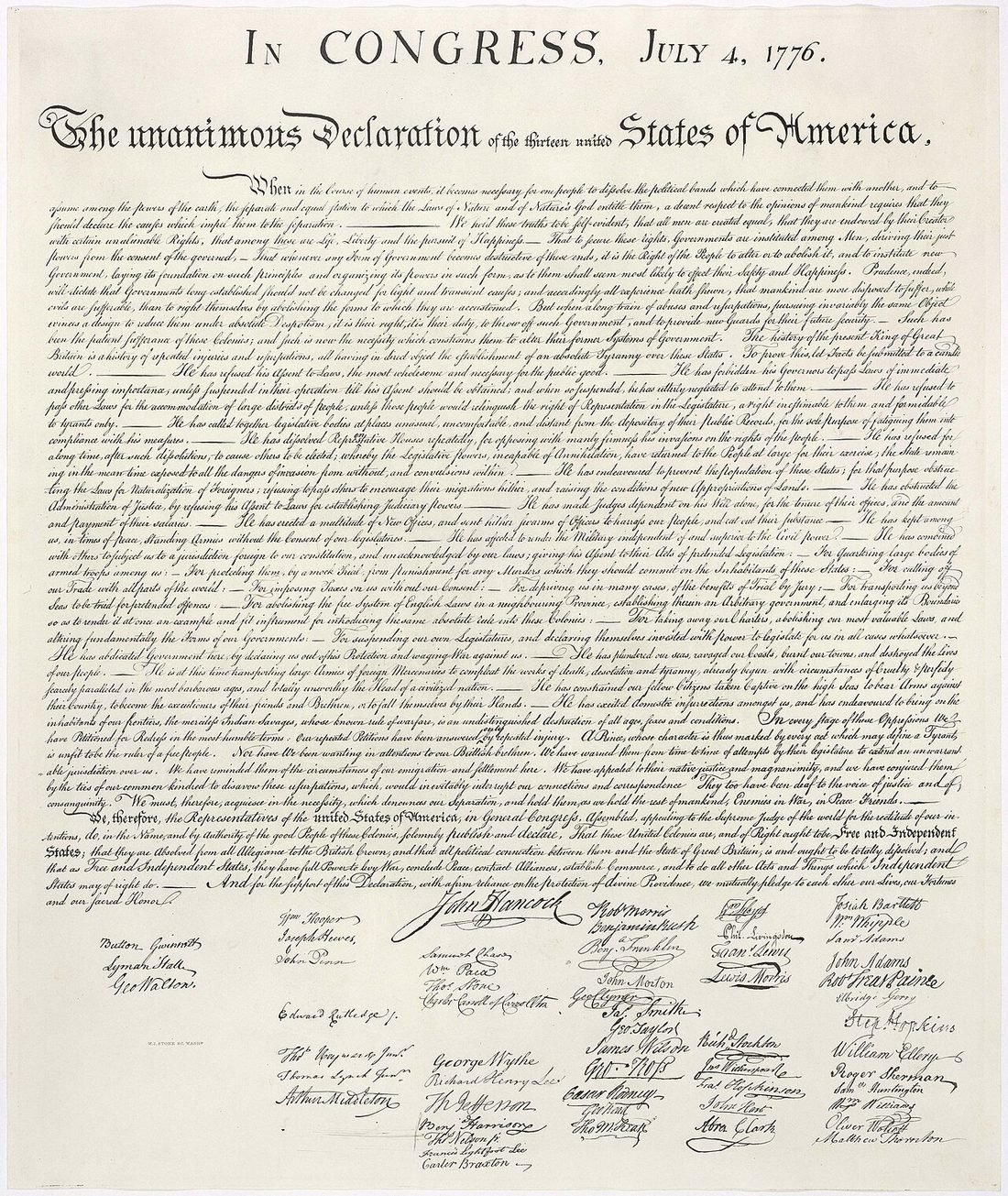
Source: National Archives
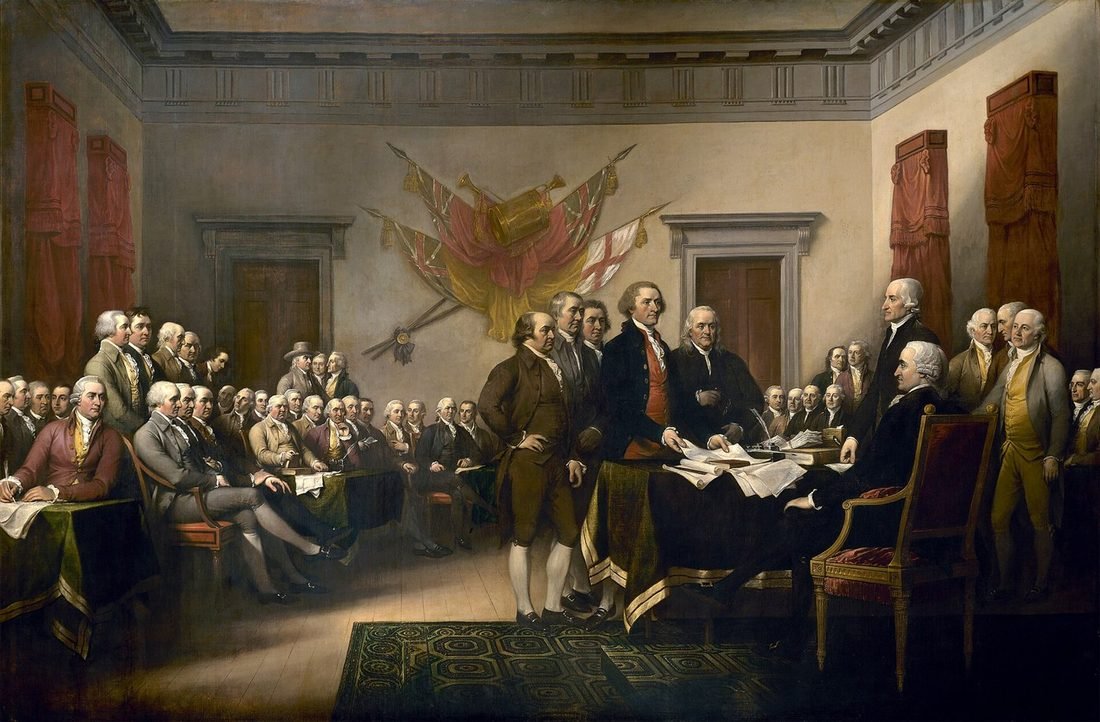
Source: U.S. Capitol
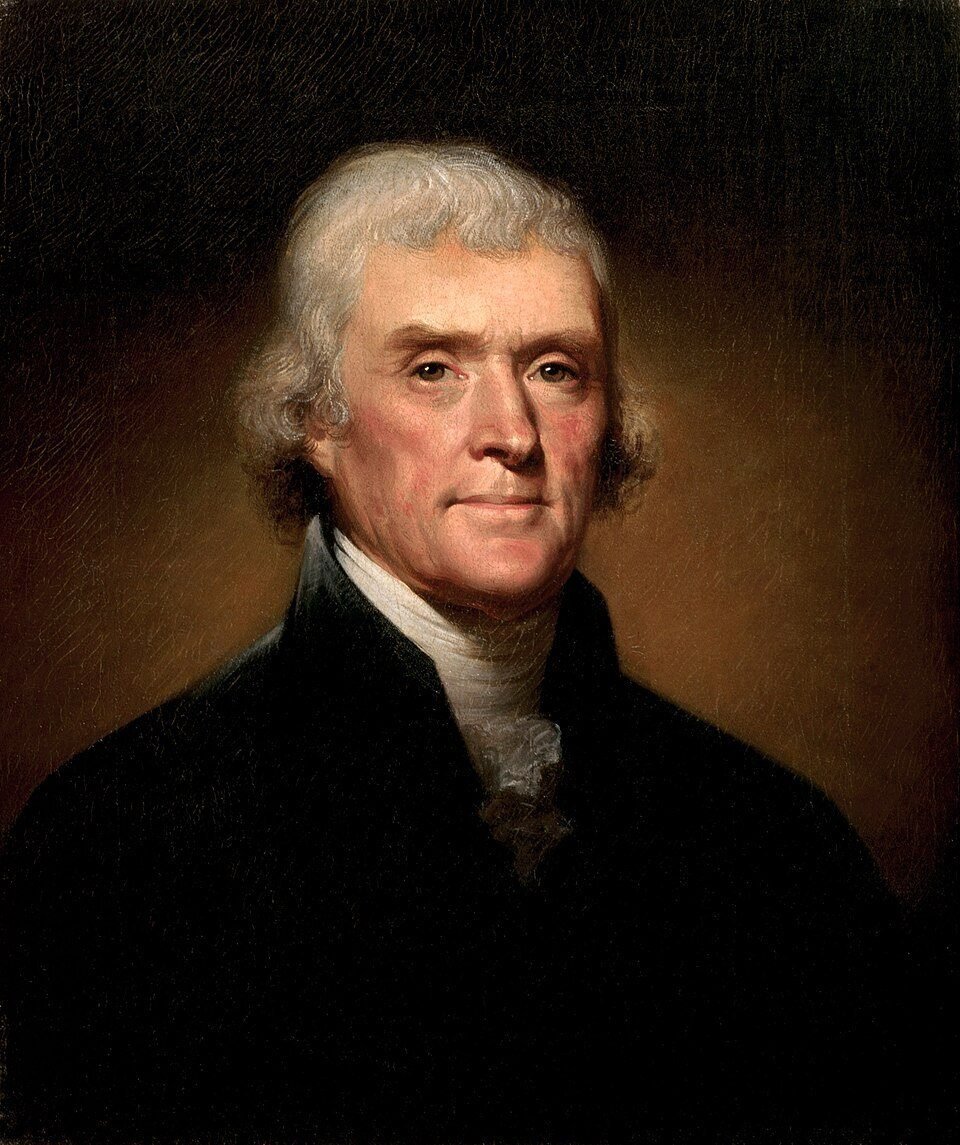
Source: Wikimedia Commons
Key Vocabulary
| Term | Definition |
|---|---|
| Unalienable rights | Rights that cannot be taken away or transferred — Jefferson listed life, liberty, and the pursuit of happiness as the primary examples. |
| Natural rights | Rights that belong to all human beings simply by virtue of being human — not granted by government and not legitimately taken by government. |
| Social contract | The philosophical idea that government is an agreement between the people and their rulers, in which the people surrender some freedom in exchange for protection of their rights. |
| Grievances | Formal complaints — the Declaration’s longest section lists 27 specific charges against King George III to justify independence. |
| Self-evident | Obvious to any reasonable person without needing proof — Jefferson’s claim that equality and natural rights are ‘self-evident truths.’ |
Story & Historical Narrative
A. Opening Lead
On June 11, 1776, the Continental Congress appointed a Committee of Five to draft a declaration of independence: John Adams, Benjamin Franklin, Roger Sherman, Robert Livingston, and Thomas Jefferson. The committee asked Jefferson to write the draft. Adams later claimed Jefferson said: ‘You are ten times the better writer.’ Jefferson retreated to his second-floor room in a Philadelphia boarding house with a portable writing desk he had designed himself, and in about two weeks produced a document that would define America for centuries. He worked, he later said, from ‘neither book nor pamphlet’ — drawing instead on ‘the harmonizing sentiments of the day.’
We explore the life of Benjamin Franklin, a printer, inventor, and diplomat whose wit, scientific curiosity, and political influence helped shape the birth of the United States. He was part of the team who negotiated the Treaty of Paris and signed both the Declaration of Independence and the Constitution.
B. The Structure of the Declaration
The Declaration has three main parts. The Preamble states the philosophical basis for independence: all men are created equal; they possess unalienable rights; government’s purpose is to secure those rights; when government fails that purpose, the people have the right to alter or abolish it. The Indictment lists 27 specific grievances against King George III — a legal brief for independence, addressed to the world. The formal Declaration announces that these united colonies are free and independent states. Each part serves a purpose: the Preamble justifies revolution in principle; the Indictment justifies this particular revolution; the Declaration seals the act.
We explore the career of Samuel Adams, a Boston patriot who led resistance against the British, signed the Declaration, and governed Massachusetts.
C. Drafting and Changes
Congress debated and revised Jefferson’s draft for several days. The most significant deletion was Jefferson’s extended passage blaming King George III for the slave trade — removed at the insistence of delegates from South Carolina and Georgia, and with the acquiescence of Northern delegates whose merchants had profited from the trade. The final document therefore proclaimed universal equality while avoiding a direct attack on slavery. That contradiction was not accidental. It was the price of unity in 1776, and it became one of the central moral failures of the founding.
D. Constitutional & Philosophical Issues
The Declaration draws heavily on John Locke’s political philosophy — but with a significant modification. Locke is often summarized as defending the natural rights of life, liberty, and property. Jefferson wrote instead of ‘Life, Liberty and the pursuit of Happiness.’ The change matters. Property implies something concrete and acquirable. The pursuit of happiness points toward a broader vision of human flourishing: the right to seek a meaningful life under a government that protects liberty rather than crushing it. The precise sources of Jefferson’s wording remain debated, but the phrase gave the Declaration a moral reach that extended far beyond property rights.
E. Long-Term Historical Impact
The Declaration’s most important legacy is the seed it planted. It proclaimed equality as the founding American principle — and then fell vastly short of living up to it. But by placing equality at the center of American identity, it gave every excluded group a constitutional weapon. When Frederick Douglass argued against slavery, he appealed to the Declaration. When Elizabeth Cady Stanton wrote the Declaration of Sentiments in 1848, she used Jefferson’s exact language. When Martin Luther King Jr. stood at the Lincoln Memorial in 1963, he called the Declaration ‘a promissory note to which every American was to fall heir.’ The Declaration did not end inequality — it defined equality as the standard against which America would always be measured.
| WHY IT MATTERS TODAY | The Declaration of Independence is America’s founding creed — the statement of what the country is supposed to be. Every time we debate whether a law is just, every time we ask whether government is serving or exploiting the people, every time we invoke the rights of the individual against the power of the state, we are working within the framework Jefferson set out on July 4, 1776. The Declaration’s promise of equality is not yet fully kept. That is why it remains alive. |
Key Takeaways
- The Declaration of Independence (1776) has three parts: the Preamble (philosophy), the Indictment (27 grievances), and the formal Declaration of independence.
- Its most famous claim — that all men are created equal with unalienable rights — is rooted in John Locke’s natural rights philosophy.
- Jefferson’s deleted passage blaming George III for the slave trade was removed after objections from Southern delegates and the acquiescence of Northern delegates connected to the trade.
- Jefferson changed Locke’s ‘property’ to ‘the pursuit of happiness’ — a significant philosophical shift.
- The Declaration planted the seed of equality that abolitionists, suffragists, and civil rights leaders would invoke for centuries.
Short Writing Assignment
Read the Declaration’s second paragraph (beginning ‘We hold these truths to be self-evident…’). In 1–2 paragraphs, explain the logical argument Jefferson makes: What are the premises? What is the conclusion? What does the argument imply about the rights of people who were excluded from its promises in 1776?
Extended Learning (Optional)
Expanded Writing Assignment
Abraham Lincoln called the Declaration ‘a standard maxim for free society.’ Frederick Douglass called it ‘a SHAM’ in 1852 — but then argued it was the most powerful antislavery document ever written. In 4–6 paragraphs, analyze what Lincoln and Douglass each meant. How can the same document be both a founding ideal and a sham? What does the Declaration promise, and to whom?
Discussion Question
Jefferson wrote that equality and natural rights are ‘self-evident.’ But he also owned more than 600 enslaved people over his lifetime and freed only a small number. Is this hypocrisy? Or can someone genuinely believe in a principle while being unable or unwilling to act on it fully? Does Jefferson’s failure discredit the Declaration’s principle — or does the principle judge Jefferson?
Primary Source Spotlight
“We hold these truths to be self-evident, that all men are created equal, that they are endowed by their Creator with certain unalienable Rights, that among these are Life, Liberty and the pursuit of Happiness. — That to secure these rights, Governments are instituted among Men, deriving their just powers from the consent of the governed, — That whenever any Form of Government becomes destructive of these ends, it is the Right of the People to alter or to abolish it…”
— Thomas Jefferson, Declaration of Independence, July 4, 1776
These words establish four foundational principles: all people are equal in fundamental dignity; they possess rights no government can legitimately take away; government’s only legitimate purpose is to protect those rights; and when government fails this purpose, the people have the right to replace it.
Extension Activity
Read Elizabeth Cady Stanton’s Declaration of Sentiments (1848). She deliberately used Jefferson’s language, substituting ‘men and women’ for ‘men.’ Write a paragraph: How effective is this rhetorical strategy? What does it reveal about the power of the Declaration’s language? What does it tell us about how excluded groups have used American founding documents to claim rights they were denied?
Explore Further
Read the Evidence
Declaration of Independence (1776)
Thomas Jefferson, original Rough draught of the Declaration of Independence
Elizabeth Cady Stanton, Declaration of Sentiments (1848)
Learn More
Danielle Allen, Our Declaration: A Reading of the Declaration of Independence in Defense of Equality
Explore
National Archives: Declaration of Independence
Liberty Tree University Resources
Videos, readings, and practice activities.
Click a title to open it.
The Founders’ Unchanging Principles of Liberty
NOTE: The following is from the July 2004 newsletter of the National Center for Constitutional Studies, www.nccs.net, an excellent website that I highly commend for your review.
As we celebrate the Declaration of Independence in July and the Constitution in September, let us once again reflect on the marvelous principles underlying these two documents. The following is a review of these principles together with a comment or a quote by the Founders. The Five Thousand Year Leap devotes 1 chapter to each of these 28 principles.
Principle 1 – The only reliable basis for sound government and just human relations is Natural Law.
Natural law is God’s law. There are certain laws which govern the entire universe, and just as Thomas Jefferson said in the Declaration of Independence, there are laws which govern in the affairs of men which are “the laws of nature and of nature’s God.”
Principle 2 – A free people cannot survive under a republican constitution unless they remain virtuous and morally strong.
“Only a virtuous people are capable of freedom. As nations become corrupt and vicious, they have more need of masters.” – Benjamin Franklin
Principle 3 – The most promising method of securing a virtuous people is to elect virtuous leaders.
“Neither the wisest constitution nor the wisest laws will secure the liberty and happiness of a people whose manners are universally corrupt. He therefore is the truest friend to the liberty of his country who tries most to promote its virtue, and who… will not suffer a man to be chosen into any office of power and trust who is not a wise and virtuous man.” – Samuel Adams
Principle 4 – Without religion the government of a free people cannot be maintained.
“Of all the dispositions and habits which lead to political prosperity, religion and morality are indispensable supports…. And let us with caution indulge the supposition that morality can be maintained without religion.” – George Washington
Principle 5 – All things were created by God, therefore upon him all mankind are equally dependent, and to him they are equally responsible .
The American Founding Fathers considered the existence of the Creator as the most fundamental premise underlying all self-evident truth. They felt a person who boasted he or she was an atheist had just simply failed to apply his or her divine capacity for reason and observation.
Principle 6 – All mankind were created equal.
The Founders knew that in these three ways, all mankind are theoretically treated as:
- Equal before God.
- Equal before the law.
- Equal in their rights.
Principle 7 – The proper role of government is to protect equal rights, not provide equal things.
The Founders recognized that the people cannot delegate to their government any power except that which they have the lawful right to exercise themselves.
Principle 8 – Mankind are endowed by God with certain unalienable rights.
“Those rights, then, which God and nature have established, and are therefore called natural rights, such as are life and liberty, need not the aid of human laws to be more effectually invested in every man than they are; neither do they receive any additional strength when declared by the municipal [or state] laws to be inviolable. On the contrary, no human legislation has power to abridge or destroy them, unless the owner [of the right] shall himself commit some act that amounts to a forfeiture.” – William Blackstone
Principle 9 – To protect human rights, God has revealed a code of divine law.
“The doctrines thus delivered we call the revealed or divine law, and they are to be found only in the Holy Scriptures. These precepts, when revealed, are found by comparison to be really a part of the original law of nature, as they tend in all their consequences to man’s felicity.” – William Blackstone
Principle 10 – The God-given right to govern is vested in the sovereign authority of the whole people.
“The fabric of American empire ought to rest on the solid basis of the consent of the people. The streams of national power ought to flow immediately from that pure, original fountain of all legislative authority.” – Alexander Hamilton
Principle 11 – The majority of the people may alter or abolish a government which has become tyrannical.
“Prudence, indeed, will dictate that governments long established should not be changed for light and transient causes… but when a long train of abuses and usurpations… evinces a design to reduce them under absolute despotism, it is their right, it is their duty, to throw off such government, and to provide new guards for their future security.” – Thomas Jefferson in the Declaration of Independence
Principle 12 – The United States of America shall be a republic.
“I pledge allegiance to the flag of the United States of America
And to the republic for which it stands….”
Principle 13 – A Constitution should protect the people from the frailties of their rulers.
“If angels were to govern men, neither external nor internal controls on government would be necessary…. [But lacking these] you must first enable the government to control the governed; and in the next place oblige it to control itself.” – James Madison
Principle 14 – Life and liberty are secure only so long as the rights of property are secure .
John Locke reasoned that God gave the earth and everything in it to the whole human family as a gift. Therefore the land, the sea, the acorns in the forest, the deer feeding in the meadow belong to everyone “in common.” However, the moment someone takes the trouble to change something from its original state of nature, that person has added his ingenuity or labor to make that change. Herein lies the secret to the origin of “property rights.”
Principle 15 – The highest level of prosperity occurs when there is a free-market economy and a minimum of government regulations.
Prosperity depends upon a climate of wholesome stimulation with four basic freedoms in operation:
- The Freedom to try.
- The Freedom to buy.
- The Freedom to sell.
- The Freedom to fail.
Principle 16 – The government should be separated into three branches .
“I call you to witness that I was the first member of the Congress who ventured to come out in public, as I did in January 1776, in my Thoughts on Government… in favor of a government with three branches and an independent judiciary. This pamphlet, you know, was very unpopular. No man appeared in public to support it but yourself.” – John Adams
Principle 17 – A system of checks and balances should be adopted to prevent the abuse of power by the different branches of government.
“It will not be denied that power is of an encroaching nature and that it ought to be effectually restrained from passing the limits assigned to it.” – James Madison
Principle 18 – The unalienable rights of the people are most likely to be preserved if the principles of government are set forth in a written Constitution.
The structure of the American system is set forth in the Constitution of the United States and the only weaknesses which have appeared are those which were allowed to creep in despite the Constitution.
Principle 19 – Only limited and carefully defined powers should be delegated to government, all others being retained by the people.
The Tenth Amendment is the most widely violated provision of the bill of rights. If it had been respected and enforced, America would be an amazingly different country than it is today. This amendment provides:
“The powers not delegated to the United States by the Constitution, nor prohibited by it to the States, are reserved to the States respectively, or to the people.”
Principle 20 – Efficiency and dispatch require that the government operate according to the will of the majority, but constitutional provisions must be made to protect the rights of the minority.
“Every man, by consenting with others to make one body politic under one government, puts himself under an obligation to every one of that society to submit to the determination of the majority, and to be concluded [bound] by it.” – John Locke
Principle 21 – Strong local self-government is the keystone to preserving human freedom.
“The way to have good and safe government is not to trust it all to one, but to divide it among the many, distributing to every one exactly the functions he is competent [to perform best]. – Thomas Jefferson
Principle 22 – A free people should be governed by law and not by the whims of men.
“The end of law is not to abolish or restrain, but to preserve and enlarge freedom. For in all the states of created beings, capable of laws, where there is no law there is no freedom. For liberty is to be free from restraint and violence of others, which cannot be where there is no law.” – John Locke
Principle 23 – A free society cannot survive as a republic without a broad program of general education.
“They made an early provision by law that every town consisting of so many families should be always furnished with a grammar school. They made it a crime for such a town to be destitute of a grammar schoolmaster for a few months, and subjected it to a heavy penalty. So that the education of all ranks of people was made the care and expense of the public, in a manner that I believe has been unknown to any other people, ancient or modern. The consequences of these establishments we see and feel every day [written in 1765]. A native of America who cannot read and write is as rare… as a comet or an earthquake.” John Adams
Principle 24 – A free people will not survive unless they stay strong.
“To be prepared for war is one of the most effectual means of preserving peace.” – George Washington
Principle 25 – “Peace, commerce, and honest friendship with all nations — entangling alliances with none.”-Thomas Jefferson, given in his first inaugural address.
Principle 26 – The core unit which determines the strength of any society is the family; therefore the government should foster and protect its integrity.
“There is certainly no country in the world where the tie of marriage is more respected than in America, or where conjugal happiness is more highly or worthily appreciated.” – Alexis de Tocqueville
Principle 27 – The burden of debt is as destructive to human freedom as subjugation by conquest.
“We are bound to defray expenses [of the war] within our own time, and are unauthorized to burden posterity with them…. We shall all consider ourselves morally bound to pay them ourselves and consequently within the life [expectancy] of the majority.” – Thomas Jefferson
Principle 28 – The United States has a manifest destiny to eventually become a glorious example of God’s law under a restored Constitution that will inspire the entire human race.
The Founders sensed from the very beginning that they were on a divine mission. Their great disappointment was that it didn’t all come to pass in their day, but they knew that someday it would. John Adams wrote:
“I always consider the settlement of America with reverence and wonder, as the opening of a grand scene and design in Providence for the illumination of the ignorant, and the emancipation of the slavish part of mankind all over the earth.”
I once again commend these to you. Freedom-loving citizens, young and older, find that memorizing these principles proves to be a valuable asset in their defense of our liberty.
— Earl Taylor, Jr., National Center for Constitutional Studies (July 2004 newsletter)
Practice activities — click one to open it:
Principles of Liberty 1 thru 7
Fill in each blank, then click Check answers.
This activity needs JavaScript.
Principles of Liberty 8 thru 14
Fill in each blank, then click Check answers.
This activity needs JavaScript.
Principles of Liberty 15 thru 21
Fill in each blank, then click Check answers.
This activity needs JavaScript.
Principles of Liberty 22 thru 28
Fill in each blank, then click Check answers.
This activity needs JavaScript.
Principles of Liberty
Lesson 2: Proclaim Liberty Throughout All the Land (NCCS)
Practice activities — click one to open it:
Principles of Liberty – Scavenger Hunt
Use the “Founders’ Unchanging Principles of Liberty” reading in this lesson to fill in each blank.
This activity needs JavaScript.
Principles of Liberty – Ordered List
This activity needs JavaScript.
Principles of Liberty – Rags to Riches
This activity needs JavaScript.
The 5000 Year Leap
Principle of Sound Religion
Identifying the Basic Beliefs of All Religions
Several of the Founders have left us with descriptions of their basic religious beliefs, and Benjamin Franklin summarized those which he felt were the “fundamental points in all sound religion.” This is the way he said it in a letter to Ezra Stiles, president of Yale University:
“Here is my creed: I believe in one God, the Creator of the universe. That he governs it by his providence. That he ought to be worshipped. That the most acceptable service we render to him is in doing good to his other children. That the soul of man is immortal, and will be treated with justice in another life respecting its conduct in this. These I take to be the fundamental points in all sound religion.”
The five points of fundamental religious belief expressed or implied in Franklin’s statement are these:
- There exists a Creator who made all things, and mankind should recognize and worship Him.
- The Creator has revealed a moral code of behavior for happy living which distinguishes right from wrong.
- The Creator holds mankind responsible for the way they treat each other.
- All mankind live beyond this life.
- In the next life mankind are judged for their conduct in this one.
Signers of the Declaration of Independence
Founding Fathers’ Quotations
Bill Whittle: What We Believe
Classical Liberalism
Enroll in American History 101
This lesson is free to read. Enroll to unlock all 48 lessons, the quizzes, and your Certificate of Completion.
One Time
Get lifetime access to American History 101: Pre-Colonial to Civil War
for a single one-time payment.
- 48 self-paced lessons spanning pre-colonial America through the Civil War
- A quiz with every lesson, plus a full final exam
- Exclusive “alternative perspectives” on pivotal moments other courses overlook
- Designed for high school, homeschool, and adult education
- Pay once — no subscriptions, no renewals