
Back to: AMERICAN HISTORY 101: PRE-COLONIAL TO CIVIL WAR
Lesson 45 – The Election of 1860 and Secession: Constitutional Crisis and the Meaning of Democratic Elections
| THEME | Lincoln won without a single southern electoral vote — and before he was inaugurated, seven states had left the Union. The fundamental question of American democracy was now being answered by force. |
Summary
The presidential election of 1860 was one of the most consequential in American history. Four candidates ran; Abraham Lincoln won without a single southern electoral vote. Before Lincoln was even inaugurated, seven southern states had seceded, formed the Confederate States of America, and begun seizing federal property. The fundamental question of whether a democratic election result could be refused — by force — was now the central question of American existence.
As the southern states are succeeding, Lincoln begins his journey to Washington, DC but encounters fierce enemies along the way, in this clip from “The Railsplitter.” Watch Abraham Lincoln on The History Channel, a three night event premiering Sunday, 2/20, through Tuesday, 2/22, at 8/7c.
Learning Objectives
By the end of this lesson, you should be able to:
- Explain why the Democratic Party split in 1860 and how that ensured Lincoln’s victory.
- Describe the secession crisis and the constitutional arguments made for and against it.
- Analyze Lincoln’s position on secession in his First Inaugural Address.
Visual Context
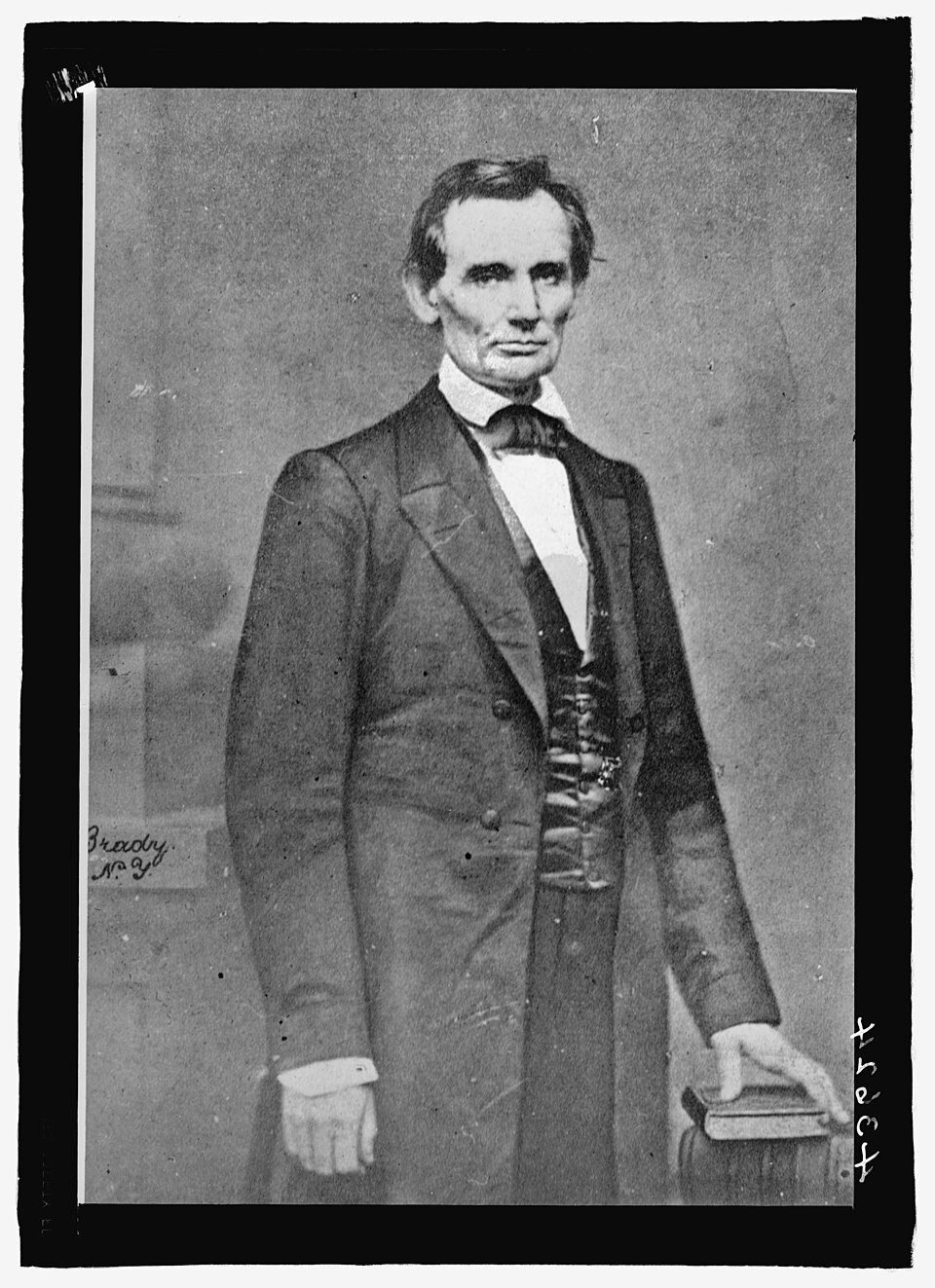
Source: Library of Congress
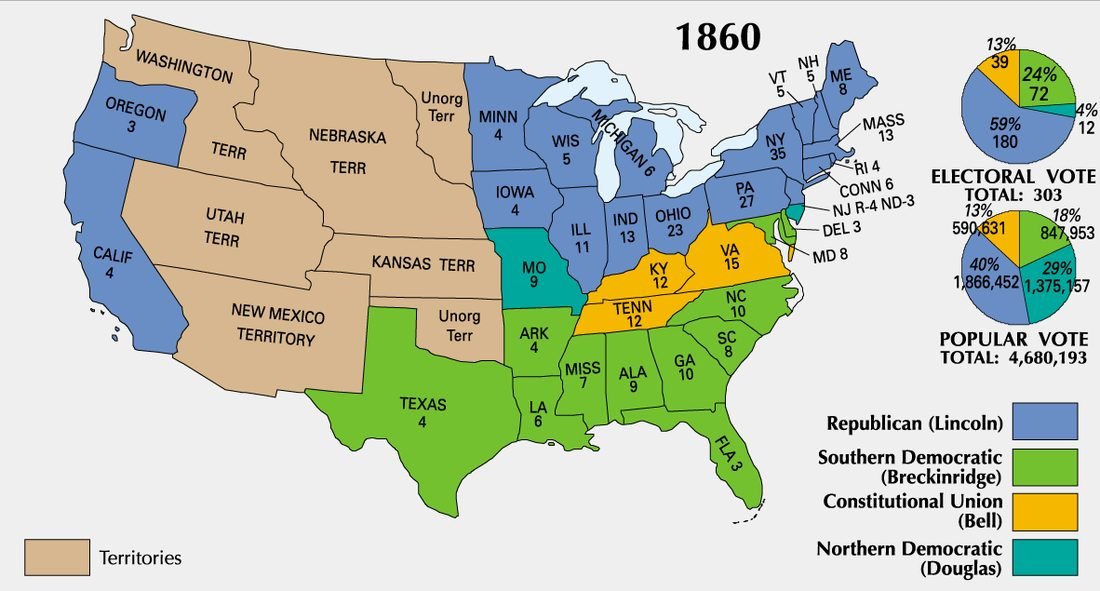
Source: Wikimedia Commons
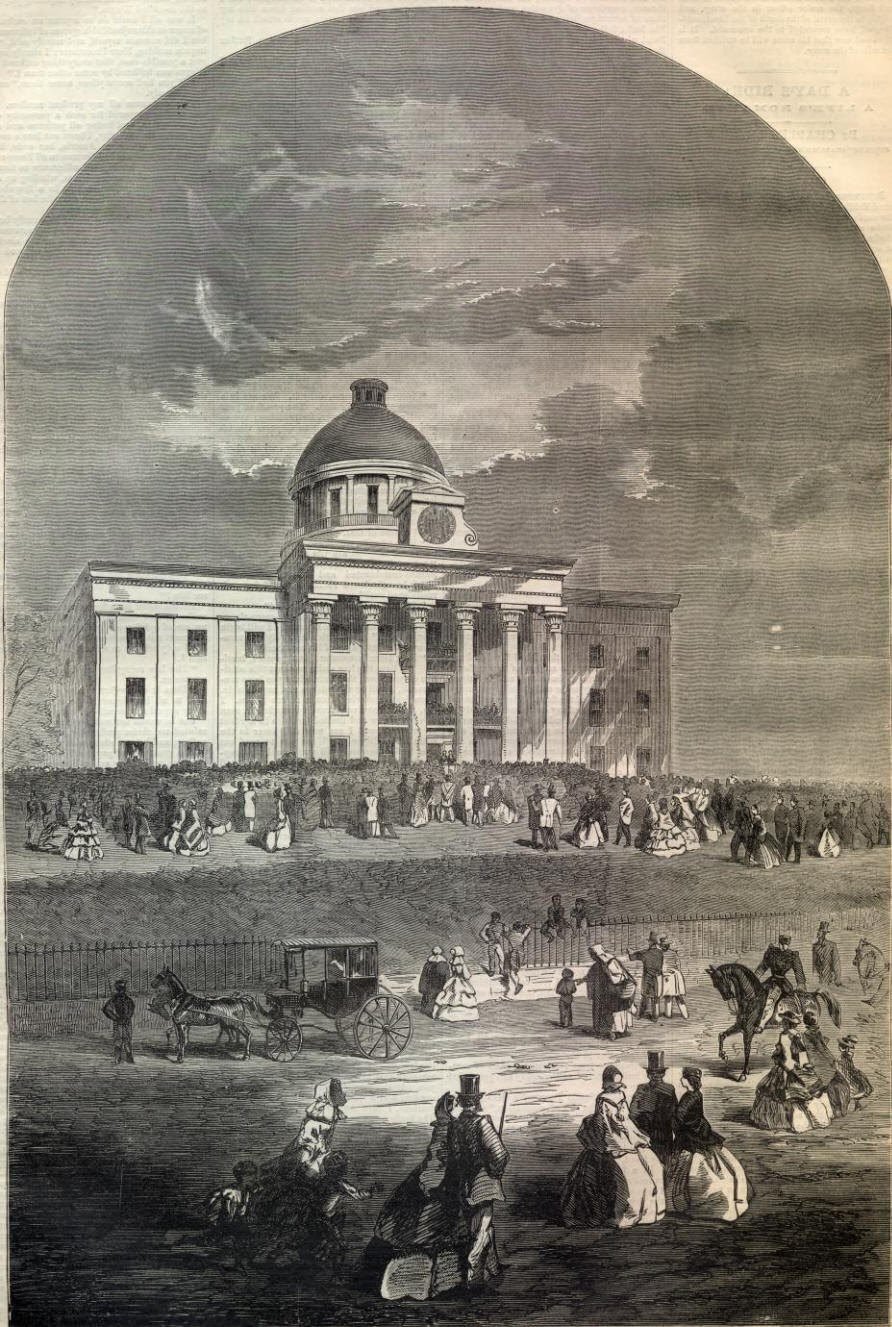
Source: Wikimedia Commons
Key Vocabulary
| Term | Definition |
|---|---|
| Republican Party (1860) | The antislavery party that nominated Abraham Lincoln; it did not compete in the South and won the presidency with northern votes alone. |
| Secession | The act of a state withdrawing from the Union — the constitutional basis for which was fiercely disputed. |
| Confederate States of America | The government formed by seven (later eleven) seceding southern states in February 1861, with Jefferson Davis as president. |
| Crittenden Compromise | A last-ditch 1860 attempt to avert secession by permanently extending the Missouri Compromise line to the Pacific — rejected by Lincoln. |
| First Inaugural Address | Lincoln’s March 4, 1861 speech calling secession legally void and appealing to southern loyalty to the Union. |
Story & Historical Narrative
A. A Four-Way Race
The Democratic Party shattered at its 1860 convention. Northern Democrats nominated Stephen Douglas; Southern Democrats nominated John C. Breckinridge; the Constitutional Union Party nominated John Bell. Lincoln, running only in the North, won decisively in the Electoral College with 180 electoral votes — without winning a single southern state.
B. Secession Begins
South Carolina called a state convention and voted to secede on December 20, 1860 — six weeks after Lincoln’s election. Mississippi, Florida, Alabama, Georgia, Louisiana, and Texas followed by February 1861. On February 4, delegates from six states met in Montgomery, Alabama, to form the Confederate States of America. Jefferson Davis of Mississippi was elected provisional president.
Allen Guelzo talks about Southern secession and “states’ rights.” __________________________________________________________________________ Khan Academy and National Constitution Center Constitution 101 – Unit 7
C. Was Secession Constitutional?
The Confederate states argued they had voluntarily entered the Union and had the right to voluntarily leave — a states’ rights argument with roots in Calhoun’s nullification theory. Lincoln argued that the Constitution created a permanent union and that the Confederate government was simply an insurrection against federal law. The Constitution itself was silent on the question. Lincoln firmly opposed the Crittenden Compromise because it would have protected slavery’s expansion into new territories — the one issue on which he would not compromise.
D. Lincoln’s First Inaugural and Fort Sumter
Lincoln declared secession legally void: ‘No state upon its own mere motion can lawfully get out of the Union.’ He promised not to interfere with slavery where it already existed and appealed to the ‘mystic chords of memory.’ Then came the trigger: Confederate batteries opened fire on Fort Sumter on April 12, 1861. Anderson surrendered after 34 hours. The Civil War had begun. Virginia, North Carolina, Tennessee, and Arkansas — which had not seceded after the election — now seceded in response to Lincoln’s call for troops.
Beginning on April 12, 1861, over the course of two days, more than 3,300 shells and cannon balls rained across Charleston Harbor towards Fort Sumter, the first shots fired in the Civil War.
| WHY IT MATTERS TODAY | The secession crisis asked the fundamental question of whether a democratic election result must be accepted, or whether it can be resisted by force. Lincoln’s answer — that a lawful election must be accepted, and that attempting to overturn it by violence is insurrection — remains a foundational principle of American constitutional democracy. |
Key Takeaways
- Lincoln won in 1860 with only northern votes after the Democratic Party split.
- Seven southern states seceded before Lincoln was inaugurated.
- Lincoln declared secession legally void and called on southern loyalty to the Union.
- Confederate bombardment of Fort Sumter on April 12, 1861 began the Civil War.
Short Writing Assignment
Read Lincoln’s closing lines from the First Inaugural: ‘We are not enemies, but friends. We must not be enemies.’ Write a paragraph analyzing what Lincoln was trying to achieve with this appeal, and whether you think it could have worked.
Extended Learning (Optional)
Expanded Writing Assignment
Research the secession declarations issued by South Carolina, Georgia, Mississippi, and Texas. What reasons do they give for secession? Write an analytical essay examining these primary sources as evidence of what the Confederate states were fighting for.
Discussion Question
Should Lincoln have let the southern states go in peace? Some historians argue that a negotiated separation would have saved hundreds of thousands of lives. Others say accepting secession would have destroyed constitutional government. What do you think, and why?
Primary Source Spotlight
“We are not enemies, but friends. We must not be enemies. Though passion may have strained it must not break our bonds of affection. The mystic chords of memory, stretching from every battlefield and patriot grave to every living heart and hearthstone all over this broad land, will yet swell the chorus of the Union, when again touched, as surely they will be, by the better angels of our nature.”
— Abraham Lincoln, First Inaugural Address, March 4, 1861
Lincoln’s closing appeal was written for him by Secretary of State William Seward and revised by Lincoln into this extraordinary passage. Its beauty made the Confederate decision to go to war seem even more tragic — Lincoln was reaching across the divide, and secessionists refused the hand. The phrase ‘better angels of our nature’ has become one of the most quoted in American political life.
Extension Activity
Research the Confederate Constitution of 1861. How was it similar to and different from the U.S. Constitution? What specific protections for slavery did it include? What does it reveal about what the Confederate founders believed they were creating?
Explore Further
Read the Evidence
Read South Carolina’s Declaration of Secession and Lincoln’s First Inaugural Address.
Learn More
James M. McPherson, Battle Cry of Freedom — chapters on the election of 1860 and secession.
Elizabeth R. Varon, Disunion! — a history of secessionist language and ideology.
Explore
National Archives and Library of Congress collections on the election of 1860 and secession documents.
Enroll in American History 101
This lesson is free to read. Enroll to unlock all 48 lessons, the quizzes, and your Certificate of Completion.
One Time
Get lifetime access to American History 101: Pre-Colonial to Civil War
for a single one-time payment.
- 48 self-paced lessons spanning pre-colonial America through the Civil War
- A quiz with every lesson, plus a full final exam
- Exclusive “alternative perspectives” on pivotal moments other courses overlook
- Designed for high school, homeschool, and adult education
- Pay once — no subscriptions, no renewals