
Back to: AMERICAN HISTORY 102: CIVIL WAR RECONSTRUCTION TO PRESENT
Lesson 54 – The 14th Amendment: Citizenship, Equal Protection, and Due Process
| THEME | The 14th Amendment is arguably the most important addition to the Constitution since the Bill of Rights. It made formerly enslaved people and other Black Americans citizens, required states to provide equal protection of the laws, and laid the groundwork for many major civil rights decisions of the 20th and 21st centuries. |
Summary
Passed by Congress in 1866 and ratified in 1868, the 14th Amendment addressed a fundamental gap in the original Constitution: it never clearly defined who was a citizen or what rights citizenship conferred. The Supreme Court’s Dred Scott decision of 1857 had declared that Black Americans — free or enslaved — could never be citizens. The 14th Amendment overturned that ruling completely, and its equal protection and due process clauses created a constitutional framework for individual rights that courts would use for generations.
This video is part of the NEW Constitution 101 course and curriculum.
Learning Objectives
By the end of this lesson, you should be able to:
- Explain the citizenship clause of the 14th Amendment and why it was necessary.
- Describe the equal protection clause and explain its significance.
- Explain the due process clause and how it differs from the 5th Amendment’s due process protection.
- Identify how the 14th Amendment has been used in landmark Supreme Court decisions.
- Explain the amendment’s connection to the Dred Scott decision.
Visual Context
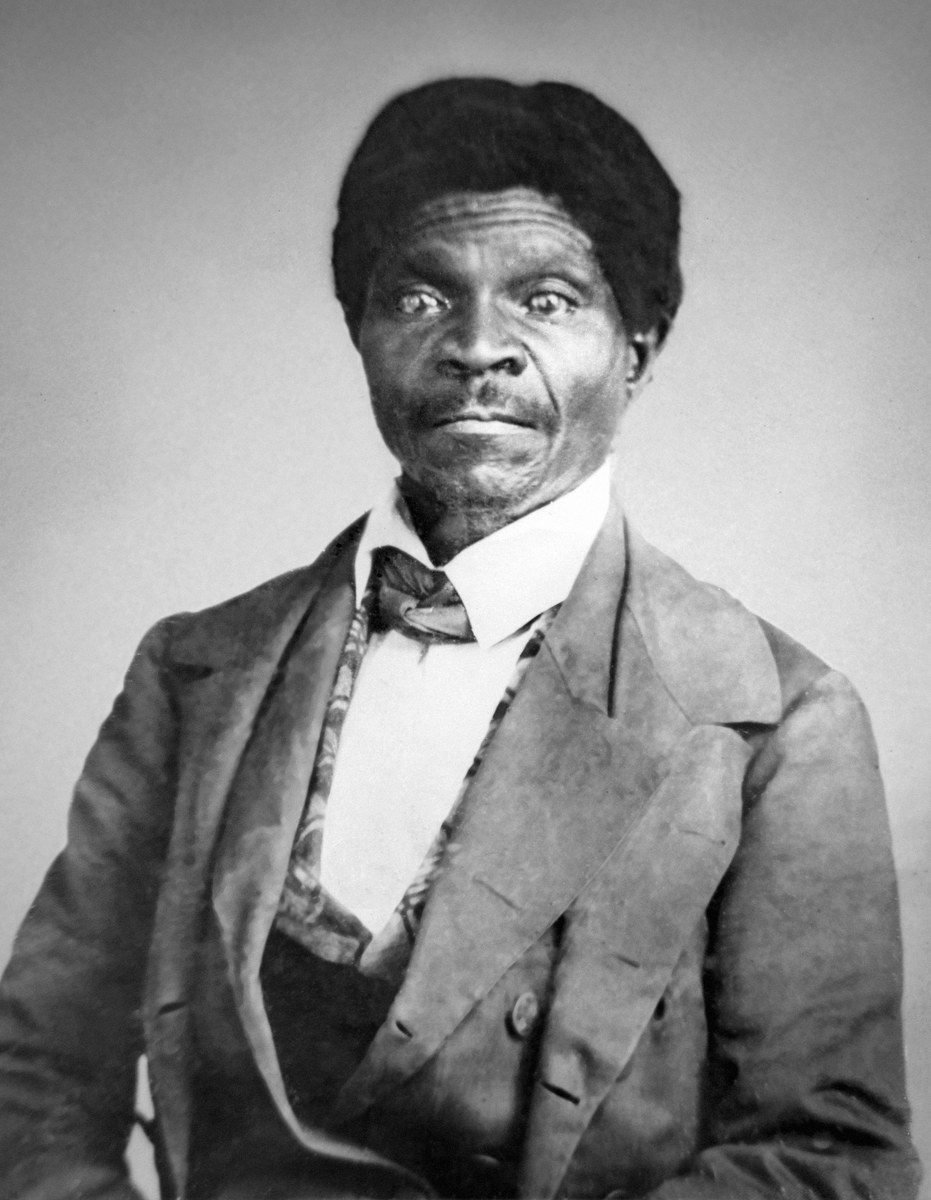
Library of Congress
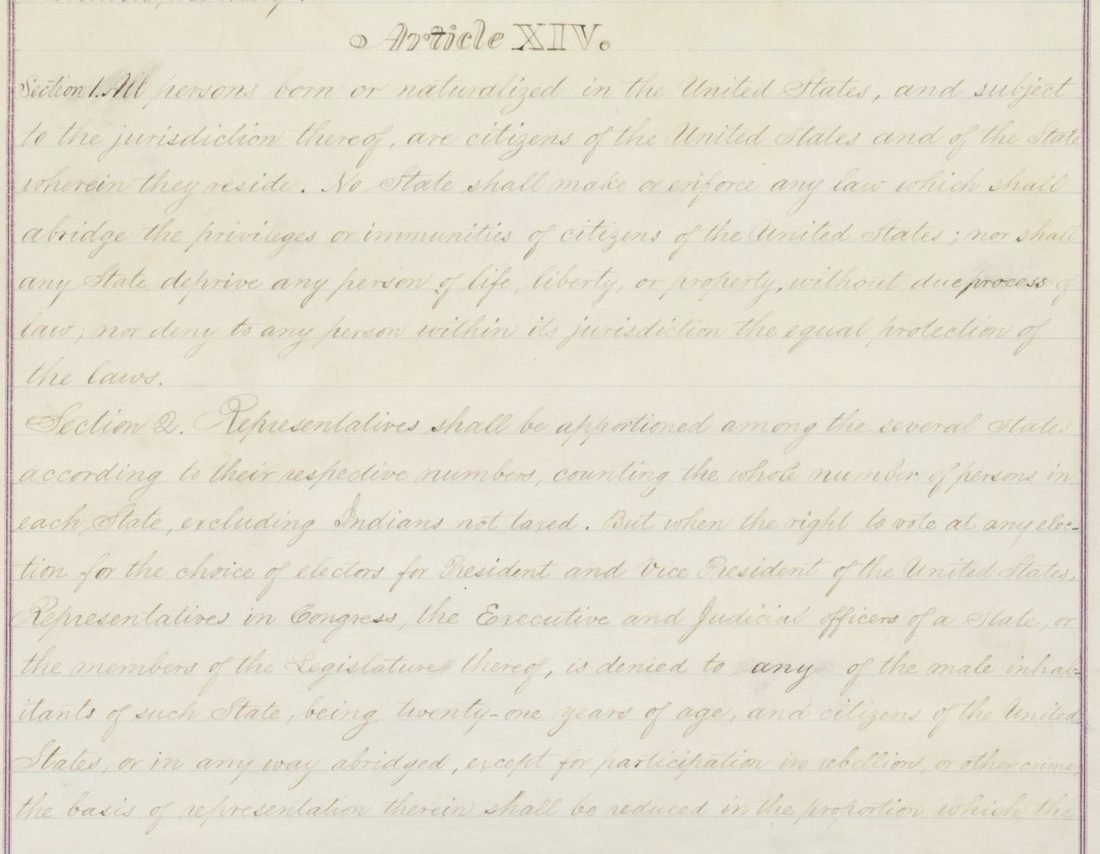
National Archives
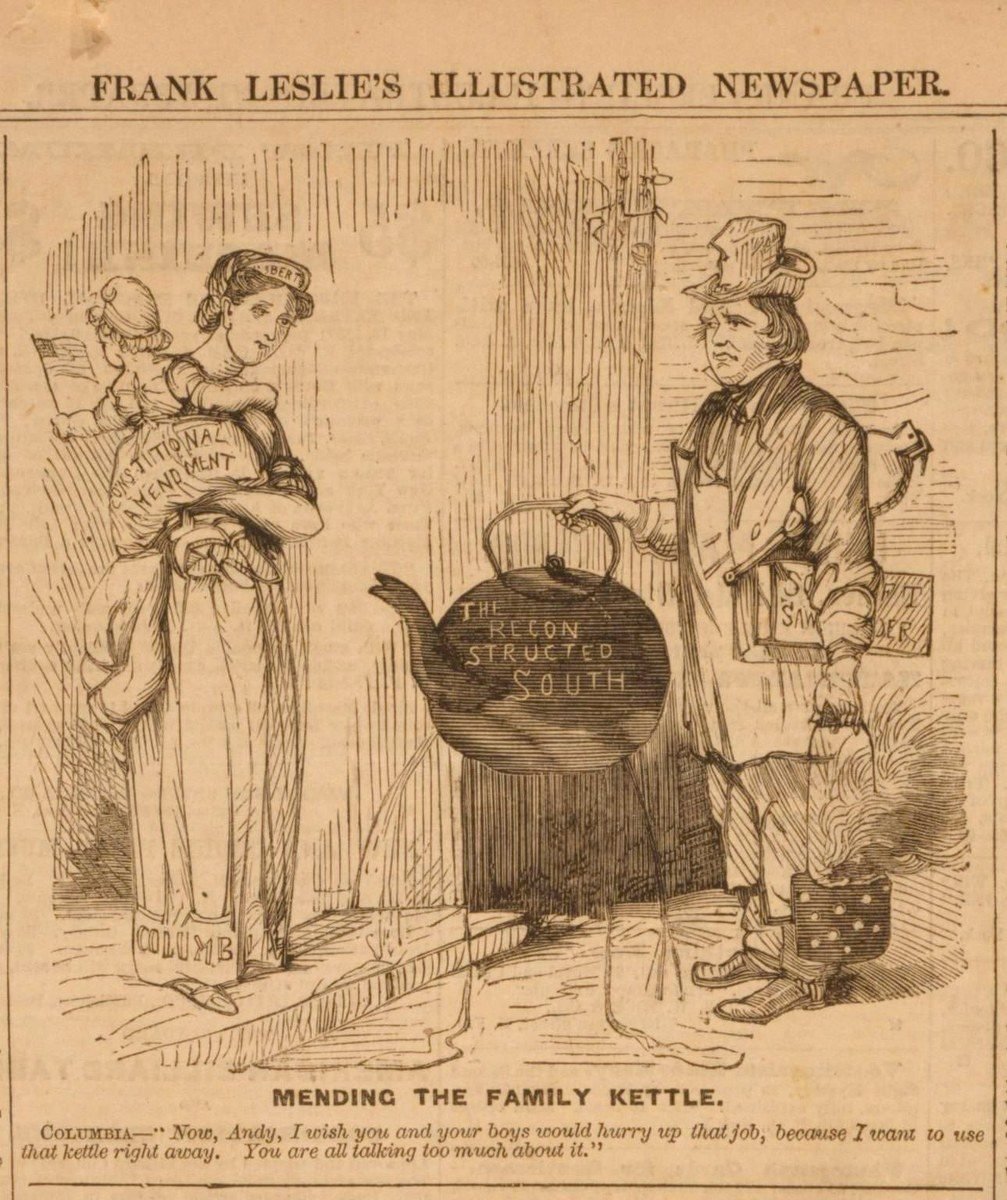
Frank Leslie’s Illustrated Newspaper — Library of Congress
Key Vocabulary
| Term | Definition |
|---|---|
| 14th Amendment | Ratified in 1868, this amendment granted citizenship to all persons born or naturalized in the United States, guaranteed equal protection under the law, and prohibited states from depriving anyone of life, liberty, or property without due process of law. |
| Citizenship clause | The section of the 14th Amendment that defines citizenship: all persons born or naturalized in the United States are citizens, overturning the Dred Scott decision. |
| Equal protection clause | The section of the 14th Amendment requiring that no state deny any person within its jurisdiction ‘the equal protection of the laws.’ This clause became the foundation for civil rights law in the 20th century. |
| Due process clause | The section of the 14th Amendment prohibiting states from depriving any person of ‘life, liberty, or property, without due process of law,’ extending fair legal procedure requirements to state governments. |
| Dred Scott v. Sandford | The 1857 Supreme Court decision declaring Black Americans could not be U.S. citizens. The 14th Amendment directly overturned this ruling. |
| Incorporation | The legal process by which the Supreme Court has applied most Bill of Rights protections to state governments through the 14th Amendment’s due process clause. |
Story and Historical Narrative
A. The Problem the 14th Amendment Solved
The original Constitution was remarkably vague about citizenship. The Dred Scott decision of 1857 made this catastrophic: Chief Justice Roger Taney ruled that Black Americans — whether enslaved or free — had no right to sue in federal court. They had, Taney wrote, ‘no rights which the white man was bound to respect.’ After the war, Congress was determined to reverse Dred Scott and put racial equality on a firm constitutional foundation.
The Dred Scott v Sandford case of 1857 was brought to the Supreme Court just four years before the start of the Civil War. Dred Scott sued his master for his freedom and Judge Robert Taney ultimately ruled two things in the Dred Scott decision.
B. The Citizenship Clause
The amendment opens with a sweeping declaration: ‘All persons born or naturalized in the United States, and subject to the jurisdiction thereof, are citizens of the United States and of the State wherein they reside.’ This single sentence overturned Dred Scott directly and permanently, established birthright citizenship, and made the formerly enslaved citizens of both the United States and their home states.
C. The Equal Protection Clause
The 14th Amendment’s most consequential provision may be its equal protection clause: ‘No state shall… deny to any person within its jurisdiction the equal protection of the laws.’ In its original context, this clause aimed at preventing Southern states from passing laws like the Black Codes. Over the next 150 years, it became a constitutional foundation for civil rights claims involving race, sex, national origin, disability, and sexual orientation.
Could an Originalist interpretation of the 14th Amendment have prevented egregious court decisions? Professor John McGinnis argues that true equality and civil rights for African Americans were intended in the 14th Amendment. In Plessy v.
D. The Due Process Clause and Incorporation
The 14th Amendment also prohibited states from depriving any person of ‘life, liberty, or property, without due process of law.’ Over time, the Supreme Court interpreted this clause to incorporate most of the Bill of Rights against state governments — meaning when a state violates your right to free speech or a fair trial, you can invoke constitutional protections originally written only to constrain the federal government.
E. The Amendment’s Long Shadow
The 14th Amendment was ratified in 1868, but its full meaning has been debated ever since. The Supreme Court narrowed its scope in the decades after ratification, allowing segregation and weakening federal civil rights protections. Not until the mid-20th century did courts begin to use the amendment as its authors intended — to require genuine equality under the law regardless of race. And courts have since extended equal protection into areas its 1868 authors almost certainly did not envision, including sex discrimination and marriage equality.
| WHY IT MATTERS TODAY | The 14th Amendment is the constitutional backbone of American civil rights law. Brown v. Board of Education, the Voting Rights Act, marriage equality, protections against sex discrimination — all rest on the equal protection and due process clauses. Understanding the 14th Amendment is not just history; it is a guide to understanding the Constitution as it operates today. |
Key Takeaways
- The 14th Amendment, ratified in 1868, overturned the Dred Scott decision and established birthright citizenship for persons born in the United States and subject to its jurisdiction.
- The equal protection clause requires states to provide equal protection of the laws — a constitutional foundation for much civil rights litigation.
- The due process clause extended fair legal procedure requirements to state governments.
- Through the doctrine of incorporation, the Supreme Court has used the 14th Amendment to apply most Bill of Rights protections to state governments.
- The 14th Amendment’s meaning has been expanded and contested over 150+ years, and it remains central to constitutional law today.
Short Writing Assignment
The equal protection clause says no state may deny any person ‘the equal protection of the laws.’ In one to two paragraphs, explain what you think this means in practice. Does it mean all people must be treated identically? Or something more nuanced? Use one real-world example to support your answer.Extended Learning (Optional)
Extended Learning (Optional)
Expanded Writing Assignment
In 4–6 paragraphs, trace the history of the equal protection clause from its passage in 1868 to a Supreme Court decision of your choice in the 20th or 21st century. How was the clause originally intended to be used? How was it ignored or undermined in the decades after Reconstruction? How did it eventually become the tool for civil rights that its authors intended?
Discussion Question
Some constitutional scholars argue the 14th Amendment should be interpreted according to its ‘original meaning.’ Others argue it should be read as a living document whose principles can be applied to new situations. Which approach do you find more persuasive? What are the risks of each?
Primary Source Spotlight
“[Black Americans] had for more than a century before been regarded as beings of an inferior order… and so far inferior, that they had no rights which the white man was bound to respect.”
— Chief Justice Roger Taney, Dred Scott v. Sandford, 1857
This is one of the most infamous sentences in Supreme Court history. The 14th Amendment was written as a direct response. How does reading Taney’s words help you understand why the amendment’s authors felt it was necessary to write birthright citizenship and equal protection into the Constitution itself?
Explore Further
Read the Evidence
• The 14th Amendment, Section 1; Civil Rights Act of 1866; United States v. Wong Kim Ark (1898).
Learn More
• Garrett Epps, Democracy Reborn: The Fourteenth Amendment and the Fight for Equal Rights in Post-Civil War America.
Explore
• National Constitution Center resources on the 14th Amendment.
The following section presents one dissenting view in the Supreme Court’s June 30, 2026 ruling on birthright citizenship (Trump v. Barbara), written by Justice Clarence Thomas and joined by Justice Neil Gorsuch. Students are encouraged to read it alongside the majority opinion, Justice Kavanaugh’s separate opinion, Justice Alito’s dissent, and the main lesson narrative, then weigh the competing historical arguments and draw their own conclusions. This remains an active legal and constitutional debate. The Court’s judgment was supported by five Justices in the majority, with Justice Kavanaugh concurring in the judgment on statutory grounds and dissenting from the constitutional holding.
The Case and What It Decided
On June 30, 2026, the Supreme Court decided Trump v. Barbara, a major constitutional case about birthright citizenship. The question was whether President Trump’s Executive Order No. 14160 — which sought to deny citizenship to children born in the United States to parents who were either unlawfully present or present on temporary visas — was lawful under the 14th Amendment’s Citizenship Clause and the federal citizenship statute.
The Court struck down the executive order. Chief Justice Roberts wrote for a five-Justice majority on the constitutional question, holding that children born in the United States to parents unlawfully or temporarily present are ‘subject to the jurisdiction’ of the United States and are citizens at birth under the 14th Amendment.
The lineup was nuanced. Justice Kavanaugh agreed the executive order was unlawful but only because it violated a federal statute, not because the Constitution itself resolved the issue. Three justices — Thomas, Alito, and Gorsuch — dissented entirely. Justice Thomas’s dissent presents a detailed originalist challenge to the modern understanding of birthright citizenship.
The Core Dispute: What Does ‘Subject to the Jurisdiction’ Mean?
The 14th Amendment’s Citizenship Clause reads: ‘All persons born or naturalized in the United States, and subject to the jurisdiction thereof, are citizens of the United States.’ Everyone in this case agreed on what ‘born in the United States’ means. The entire dispute turned on four words: subject to the jurisdiction thereof.
The majority, following the 1898 precedent United States v. Wong Kim Ark, interpreted ‘subject to the jurisdiction’ to mean: subject to the governing power of the United States — which applies to virtually everyone physically present in the country, with narrow exceptions for diplomats, foreign military forces in hostile occupation, and historically members of Indian tribes governing themselves as separate sovereignties.
Justice Thomas argued that ‘the Civil Rights Act and the Citizenship Clause guaranteed citizenship to persons born and domiciled in the United States regardless of their race — but that neither guaranteed citizenship to persons who were not domiciled in the United States.’ The word domicile is central to his argument. Domicile means more than physical presence — it means the place where a person has established a permanent legal home. On Thomas’s reading, the 14th Amendment was written to guarantee citizenship to those born to parents domiciled in America, not to every child whose parents happened to be on American soil at the moment of birth.
Thomas’s Historical Argument
Justice Thomas is an originalist — he believes the Constitution’s meaning is fixed at the time it was written, and that interpreting it correctly requires understanding what its words meant to the people who wrote and ratified it. His dissent is primarily a historical argument: that the majority’s interpretation of ‘subject to the jurisdiction’ gets the history wrong.
1. The 14th Amendment was written to fix a specific problem — Dred Scott — not to create universal birthright citizenship for all children of foreign visitors.
Thomas argued that the 14th Amendment was primarily aimed at formerly enslaved Black people. The Citizenship Clause’s purpose, he argued, was to overturn Dred Scott v. Sandford (1857) and guarantee citizenship to the freed slaves and their descendants — people who had been born on American soil, had no other homeland, owed no allegiance to any foreign power, and had in every practical sense made America their home. On his reading, the Clause was designed to protect people in that specific situation, not to extend automatic citizenship to the children of anyone physically present in the United States.
2. ‘Subject to the jurisdiction’ historically meant complete political allegiance, which required domicile.
Thomas argued that in the constitutional era, ‘jurisdiction’ in the context of citizenship carried a specific legal meaning tied to allegiance. A person was fully ‘subject to the jurisdiction’ of the United States only when they owed primary political allegiance to the United States — and that allegiance was established by domicile, by having made the United States one’s permanent home. A foreign visitor on a temporary stay, in his reading, retained primary allegiance to their home country and thus was not fully ‘subject to the jurisdiction’ in the sense the 14th Amendment intended.
3. Wong Kim Ark (1898) was more limited than the majority claims.
Thomas contended that Wong Kim Ark resolved only the narrow issue of citizenship of a child born in the United States to parents who had established a permanent domicile in the country. He argued that the famous 1898 precedent has been over-read — that it settled the question for children of permanent residents, but did not necessarily settle it for children of temporary visitors or those unlawfully present.
The Majority’s Response
Chief Justice Roberts and the majority engaged Thomas’s historical argument at length — and rejected it sharply. Roberts wrote that domicile and national citizenship are distinct concepts: ‘one who establishes a domicile in a new country does not automatically become a citizen thereof, nor does he automatically lose his prior citizenship.’ The majority found that the word ‘domicile’ appears only twice in all the congressional debates over both the Civil Rights Act of 1866 and the 14th Amendment — and in neither case was it used to define the scope of birthright citizenship.
The majority also pointed to the congressional debates, where Senator Trumbull — a key author of the Civil Rights Act — said the law would make citizens of ‘the children of Chinese and Gypsies born in this country,’ and ‘even the infant child of a foreigner born in this land is a citizen.’ The Court treated these statements as evidence that the Reconstruction Congress chose broad language rather than a domicile requirement.
Justice Jackson, in a pointed concurrence, argued that Thomas’s position created a tension: although he has often emphasized a ‘colorblind’ Constitution, his reading of the Citizenship Clause treated it as a race-conscious remedial measure focused on formerly enslaved people and those similarly situated. Jackson argued that this narrow reading was inconsistent with the universal language the Framers of the 14th Amendment actually chose.
Justice Kavanaugh’s Middle Path
Justice Kavanaugh agreed that Trump’s executive order was unlawful — but not for the constitutional reason the majority gave. In his view, Trump’s order ‘does not violate the Fourteenth Amendment’ but does violate a federal law providing that children who are ‘born in the United States, and subject to the jurisdiction thereof’ are U.S. citizens. Congress, Kavanaugh suggested, ‘could amend that law or otherwise enact new legislation establishing exceptions to birthright citizenship for children born to foreign citizens unlawfully or temporarily in the country. But Congress has not yet done so.’
Kavanaugh’s position is significant: at least four sitting Justices took the view that the Constitution does not, by itself, guarantee birthright citizenship to children of parents unlawfully or temporarily present, and that Congress could alter the statutory rule without a constitutional amendment. The majority rejected that view as a matter of constitutional interpretation.
Why This Connects to Lesson 54
The 14th Amendment was ratified in 1868 to ensure that the freed slaves and their descendants could never again be denied citizenship — to permanently overrule Dred Scott and make citizenship a matter of birth on American soil rather than race or ancestry. That was its central, undisputed purpose.
The debate in Trump v. Barbara is about what else the Amendment accomplished. Did it enshrine a broad, universal principle — that virtually anyone born on American soil is a citizen, regardless of their parents’ status? Or did it enshrine a narrower principle — that no one who has made America their home can be denied citizenship on account of race or origin — while leaving Congress free to define who qualifies as having made America their home?
Both sides of this debate claim to be faithful to the text and history of the 14th Amendment. Both sides claim to be honoring the meaning of Reconstruction. This is what makes Trump v. Barbara important for students of the 14th Amendment: it forces a genuine reckoning with what the Amendment’s words mean, what problem they were written to solve, and whether the solution is narrow and targeted or broad and universal.
Questions for Discussion
1. Justice Thomas argues that the 14th Amendment was written primarily to guarantee citizenship to the freed slaves, and that the majority has expanded it beyond that original purpose. Chief Justice Roberts argues the Amendment was written in universal language precisely to prevent any future government from drawing racial or ancestral lines around citizenship. Which interpretation do you find more historically persuasive, and why?
2. Justice Kavanaugh’s middle position suggests that Congress could change statutory birthright citizenship rules even though the majority held the Constitution itself protects birthright citizenship in this context. What are the advantages and disadvantages of leaving such questions to the legislative process rather than resolving them constitutionally?
3. The majority points out that the word ‘domicile’ appears only twice in all the congressional debates over the 14th Amendment and was never used to define the scope of birthright citizenship. Justice Thomas responds that the concept of allegiance — which domicile was understood to establish — was central to the framers’ thinking even if the word ‘domicile’ wasn’t used. How should courts weigh explicit textual evidence against implicit conceptual frameworks when interpreting constitutional history?
4. Given the Court’s ruling, what options remain for those who want to change birthright citizenship rules? What would require ordinary legislation, and what would require a constitutional amendment?
For Further Reading
Trump v. Barbara, 609 U.S. ___ (2026) — the full opinion including Roberts’s majority, Jackson’s concurrence, Kavanaugh’s partial concurrence/dissent, Thomas’s dissent, Alito’s dissent, and Gorsuch’s separate dissent: https://www.supremecourt.gov/opinions/25pdf/25-365_4hdj.pdf
United States v. Wong Kim Ark, 169 U.S. 649 (1898) — the foundational 1898 precedent that Trump v. Barbara interpreted and reaffirmed.
The 14th Amendment, Section 1 (ratified 1868) — the primary constitutional text at issue.
The Civil Rights Act of 1866 — the statutory predecessor to the Citizenship Clause, whose congressional debates are central to both sides’ historical arguments.
Enroll in American History 102
This lesson is free to read. Enroll to unlock all 48 lessons, the quizzes, and your Certificate of Completion.
One Time
Get lifetime access to American History 102: Reconstruction to the Modern Era
for a single one-time payment.
- 48 self-paced lessons from Reconstruction to the 21st century
- A quiz with every lesson, plus a full final exam
- Exclusive “alternative perspectives” on pivotal moments other courses overlook
- Designed for high school, homeschool, and adult education
- Pay once — no subscriptions, no renewals