
Back to: AMERICAN HISTORY 102: CIVIL WAR RECONSTRUCTION TO PRESENT
Lesson 78 – The 16th Amendment: The Income Tax and the Expanding Federal Government
| THEME | The 16th Amendment gave Congress the power to tax incomes — and in doing so, it fundamentally changed the financial relationship between the federal government and American citizens. The income tax made the modern federal government possible; without it, most of what Washington does today could not be funded. |
Summary
For most of American history, the federal government was funded primarily through tariffs and excise taxes. When Congress tried to pass an income tax in 1894, the Supreme Court blocked it. The 16th Amendment, ratified in 1913, eliminated the constitutional barrier. What began as a modest tax on high incomes has grown into the primary funding mechanism for the federal government — generating trillions of dollars annually and touching the lives of virtually every American.
Learning Objectives
By the end of this lesson, you should be able to:
- Explain why the federal government needed a new source of revenue in the Progressive Era.
- Describe the constitutional barrier to income taxation before the 16th Amendment.
- Explain the key features of the original income tax and how it has changed over time.
- Analyze the arguments for and against the income tax at the time of its adoption.
- Explain the connection between the income tax and the growth of federal government programs.
Visual Context
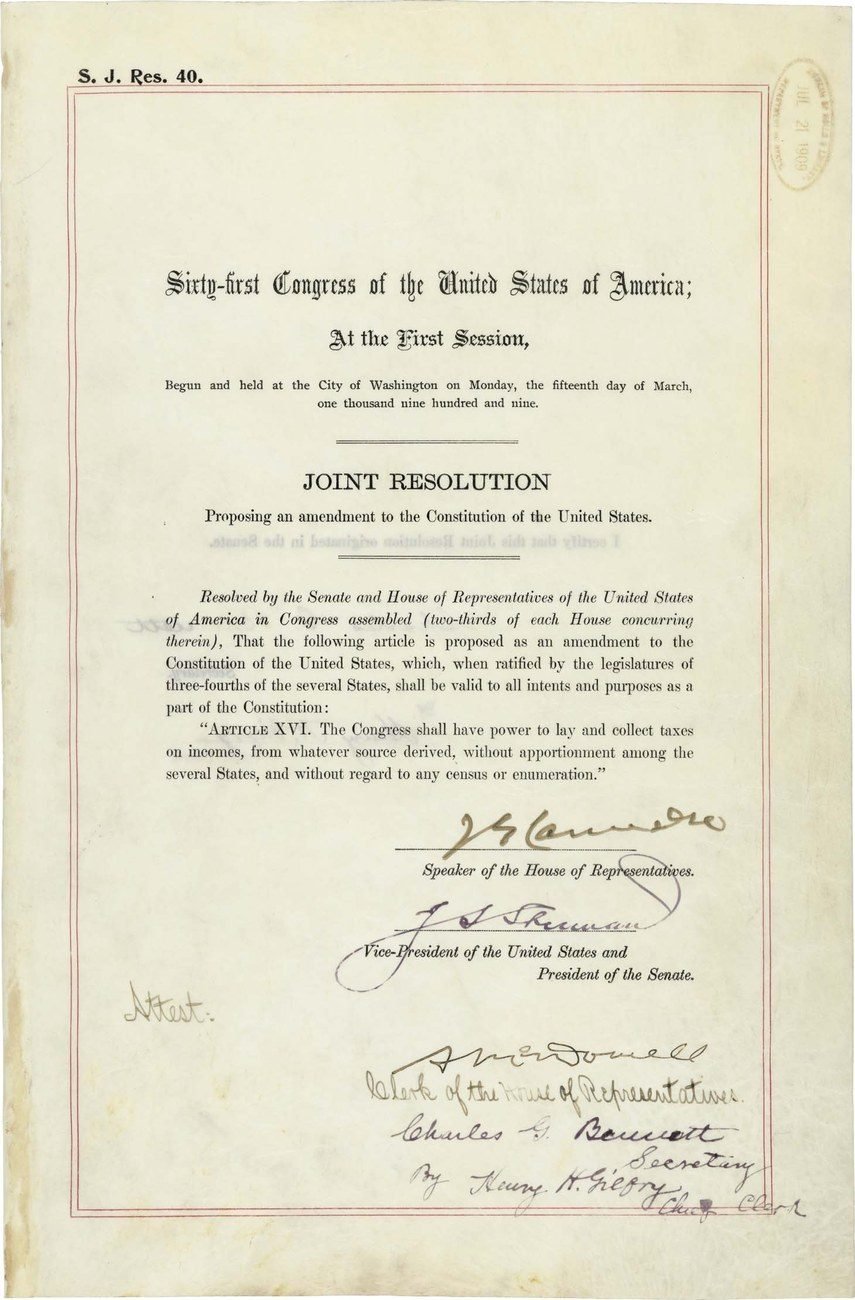
Source: Wikimedia Commons
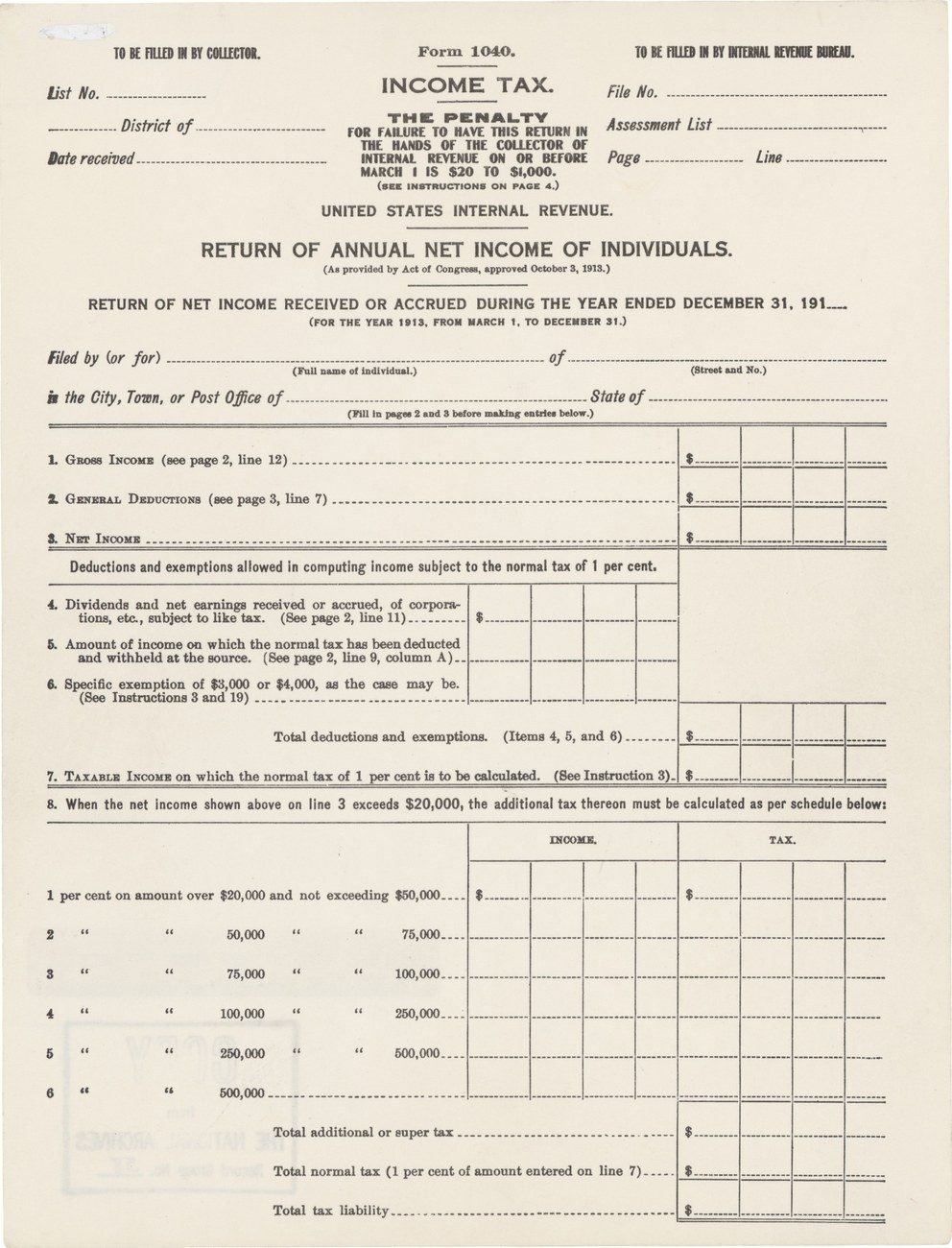
Source: Wikimedia Commons
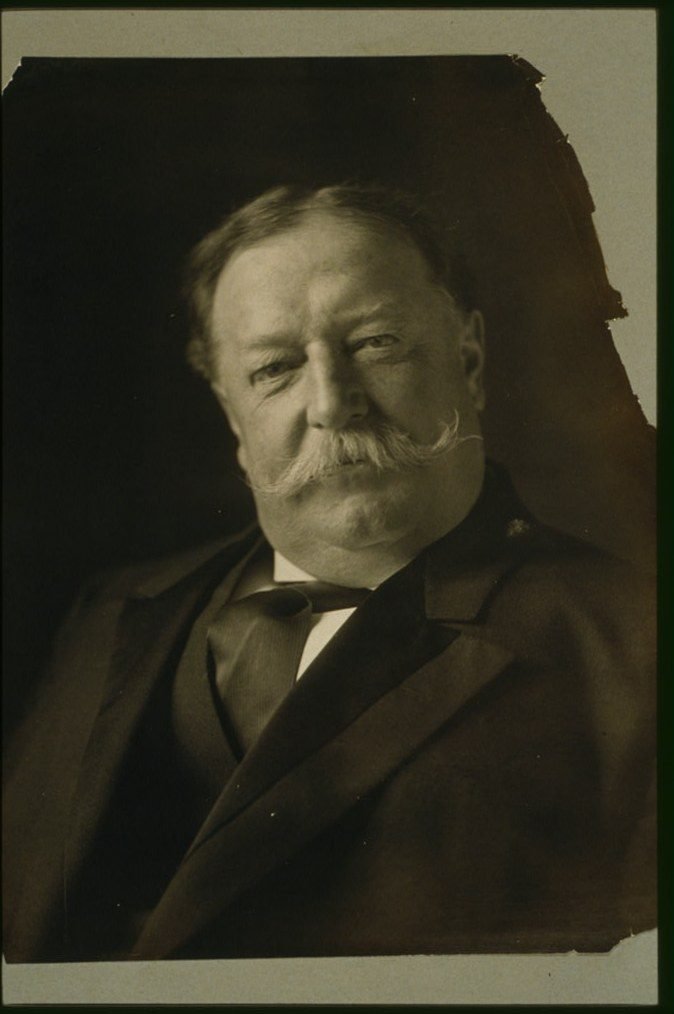
Source: Library of Congress
Key Vocabulary
| Term | Definition |
|---|---|
| 16th Amendment | Ratified in 1913, this amendment clarified Congress’s power to levy taxes on incomes ‘from whatever source derived, without apportionment among the several States.’ |
| Progressive income tax | A tax system in which higher incomes are taxed at higher rates. The original 1913 income tax was modestly progressive, with rates ranging from 1% to 7%. |
| Pollock v. Farmers’ Loan & Trust (1895) | The Supreme Court decision that struck down the income tax Congress had passed in 1894, ruling that a tax on income from property was a ‘direct tax’ requiring apportionment by state population. |
| Tariff | A tax on imported goods. Tariffs were the primary source of federal revenue throughout the 19th century. |
| Direct tax | Under the original Constitution, a tax that had to be apportioned among states according to population. The 16th Amendment overturned the application of this rule to income taxes. |
| Flat tax | A tax system in which all income is taxed at the same rate, regardless of how much one earns. |
Story and Historical Narrative
A. The Revenue Problem
In the Gilded Age, the federal government was funded almost entirely by tariffs and excise taxes — regressive sources that imposed heavier burdens on the poor than the rich. Progressives argued that an income tax would be fairer, more flexible, and better suited to funding an active government. The Populists had included a graduated income tax in their 1892 platform; by the 1900s the idea had moved into the mainstream.
B. The Constitutional Barrier
Congress passed an income tax in 1894, but the Supreme Court struck it down in Pollock v. Farmers’ Loan and Trust Company (1895), ruling 5-4 that a tax on income from property was a ‘direct tax’ requiring apportionment by state population — making a uniform national income tax constitutionally impossible without an amendment. Justice Harlan dissented sharply, arguing the ruling made it impossible for the government to tax wealth fairly.
C. The 16th Amendment
Congress quickly passed the Revenue Act of 1913, establishing the modern federal income tax under the new authority. The initial tax was modest: only about 2% of households owed income tax, and rates ranged from 1% to 7% on very high incomes.
When and why did Congress create the Internal Revenue Service? Professor Kristin Hickman gives a brief history of the origins of the IRS, dating back to the Civil War. New internal taxes were required to fund the war and a bureaucracy was created to administer them.
D. How the Tax Grew
World War I changed everything. The cost of modern industrial warfare was staggering, and the income tax proved the most practical way to fund it. Rates rose dramatically during the war — the top rate reached 77% by 1918. They fell in the 1920s but rose again during the New Deal and World War II, when the top rate reached 94%. The income tax became the permanent financial foundation of the modern federal government.
E. The Ongoing Debate
The income tax has been debated ever since its creation. Conservatives argue that high marginal rates discourage work, investment, and growth, and that a simpler flat tax would be fairer. Progressives argue that the wealthy pay lower effective rates than the middle class when all taxes are considered, and that greater progressivity is both fair and economically sound. The tax code has also become enormously complex — tax reform is a perennial political issue precisely because the income tax touches every American’s financial life.
| WHY IT MATTERS TODAY | The 16th Amendment made the modern federal government financially possible. Every debate about government spending is ultimately a debate about taxation. Understanding the income tax’s history — why it was created, how it has evolved, and what it makes possible — is essential to understanding American fiscal politics today. |
Key Takeaways
- The federal government was funded primarily by tariffs and excise taxes before the 16th Amendment — revenue sources that were regressive and inadequate for an active government.
- The Supreme Court struck down the 1894 income tax in Pollock v. Farmers’ Loan and Trust, ruling it was a ‘direct tax’ requiring apportionment — making the 16th Amendment necessary.
- The 16th Amendment, ratified in 1913, gave Congress the power to tax incomes without apportionment.
- The original income tax was modest — affecting only about 2% of Americans — but grew dramatically during wartime and the New Deal era.
- The income tax is one of the financial foundations of modern American government and remains actively debated.
Short Writing Assignment
The original income tax in 1913 was progressive — higher incomes paid higher rates. In one to two paragraphs, make the strongest case you can for either progressive taxation or a flat tax. What values and assumptions underlie each position?
Extended Learning (Optional)
Expanded Writing Assignment
In 4–6 paragraphs, trace the history of the federal income tax from the Pollock decision through the 16th Amendment and its growth during the 20th century. What political forces drove each major change? And how have debates about the income tax reflected broader American values about fairness, equality, and the proper role of government?
Discussion Question
During World War II, the top federal income tax rate reached 94% on the highest incomes. Critics today argue this would be economically devastating. But supporters argue it was both fair and economically necessary. What do you think the right top income tax rate should be, and why?
Primary Source Spotlight
“The Congress shall have power to lay and collect taxes on incomes, from whatever source derived, without apportionment among the several States, and without regard to any census or enumeration.”
— 16th Amendment to the U.S. Constitution, ratified February 3, 1913
These 30 words transformed American fiscal policy. What questions does this amendment leave unanswered, and how have those questions been resolved over time?
Explore Further
Read the Evidence
Text of the 16th Amendment and the Revenue Act of 1913.
Learn More
W. Elliot Brownlee, Federal Taxation in America; Ajay K. Mehrotra, Making the Modern American Fiscal State.
Explore
National Archives resources on constitutional amendments and federal taxation.
The following section presents a critical perspective on the 16th Amendment and the income tax, focusing on its relationship to military spending and the growth of federal power.
A. The Income Tax and the War Machine
The mainstream account presents the 16th Amendment as a Progressive Era reform — a fairer way to fund government by taxing those with the most ability to pay. The alternate perspective agrees the tax was sold this way, but argues its most consequential effect was to give the federal government a massive, elastic source of revenue that made large-scale military spending permanently possible.
Before the income tax, the federal government was financially constrained. Wars had to be financed through bond sales, tariffs, and excise taxes — methods that were visible to the public and politically costly. The income tax changed this. As the tax grew — driven by wartime spending in WWI, WWII, Korea, Vietnam, and beyond — it created a steady stream of revenue that funded not just wars but an enormous expansion of the federal bureaucracy. Critics argue this was not an accidental side effect but the purpose: the same financial interests that wanted the Federal Reserve also wanted a mechanism to fund the wars and government programs that would benefit them.
B. Who Benefits from War? A Partial List
Major General Smedley Butler asked this question in War Is a Racket. The answer, he argued, is a long list of interests that have nothing to do with national security:
- Defense contractors — weapons manufacturers, aircraft companies, shipbuilders — whose profits depend on military spending.
- Ammunition and ordnance manufacturers, who see demand spike during every conflict.
- Pharmaceutical and medical supply companies, who supply vaccines, drugs, and equipment to the military.
- Uniform and clothing manufacturers.
- Oil companies, whose product fuels every modern military operation and whose prices rise during wartime.
- Financial institutions that lend money to governments on both sides of a conflict — and collect interest regardless of who wins.
- Military officers, whose promotions and careers are accelerated by active combat.
Butler’s argument is not that individual soldiers fight for profit — most fight from duty, patriotism, and loyalty to their fellow soldiers. His argument is that the decision to go to war is made by people with financial interests in the outcome, and that the costs — death, injury, national debt — are borne by those with the least stake in the profits.
C. The ‘2% Promise’ and What Actually Happened
Supporters generally presented it as a modest tax on high incomes. During WWI, the top rate rose to 77%. It fell in the 1920s, rose again during the New Deal and World War II, and eventually became a broad-based source of federal revenue. Critics argue this history illustrates a consistent pattern: government powers, once granted, tend to expand.
Critics argue this history illustrates a consistent pattern: government powers, once granted, tend to expand. The income tax was sold as a modest, fair reform; it became the primary funding mechanism for the largest military and government apparatus in world history. Whether this expansion was a reasonable response to genuine crises or a predictable consequence of giving government a new power that special interests could exploit is a question worth considering.
D. The Constitutional Question
Some critics argue that the 16th Amendment was improperly ratified or that it does not authorize the kind of income taxation that later developed. The Constitution originally required that ‘direct taxes’ be apportioned among the states according to population, and the Pollock decision treated certain income taxes as direct taxes. The mainstream constitutional view is that the 16th Amendment removed the apportionment barrier for taxes on income.
This is a minority legal position that courts have consistently rejected. Students should be aware that it exists, understand the mainstream constitutional analysis (presented in the main lesson), and evaluate the evidence for both positions. The fact that courts have rejected an argument does not automatically mean the argument is wrong — courts have been wrong before, as the history of Plessy v. Ferguson demonstrates. But it does mean the argument faces a very high burden of proof.
The relationship between taxation, military spending, and concentrated financial power is a legitimate area of historical inquiry. The questions Clyde raises — who benefits from war, how government powers expand once granted, and whether democratic accountability over monetary and fiscal policy is adequate — deserve serious engagement. Students are encouraged to examine the evidence, consider multiple perspectives, and form their own reasoned judgments.
Liberty Tree University Resources
Videos, readings, and practice activities.
Click a title to open it.
Enroll in American History 102
This lesson is free to read. Enroll to unlock all 48 lessons, the quizzes, and your Certificate of Completion.
One Time
Get lifetime access to American History 102: Reconstruction to the Modern Era
for a single one-time payment.
- 48 self-paced lessons from Reconstruction to the 21st century
- A quiz with every lesson, plus a full final exam
- Exclusive “alternative perspectives” on pivotal moments other courses overlook
- Designed for high school, homeschool, and adult education
- Pay once — no subscriptions, no renewals