
Back to: AMERICAN HISTORY 102: CIVIL WAR RECONSTRUCTION TO PRESENT
Lesson 71 – Workers, Unions, Strikes, and the Question of Economic Liberty
| THEME | Industrial capitalism created enormous wealth — and it concentrated that wealth in very few hands, while the workers who produced it labored in dangerous conditions for wages that barely sustained life. The labor movement was the response: an attempt to organize workers to demand a fairer share of what they helped create. |
Summary
The Gilded Age was a period of spectacular industrial growth — and spectacular labor conflict. Workers in steel mills, coal mines, railroads, and garment factories worked long hours under dangerous conditions for wages set entirely by employers who had overwhelming power in the relationship. Workers who complained could be fired instantly; workers who organized could be blacklisted across an entire industry.
The labor movement fought back — through strikes, boycotts, political organizing, and the slow, painful work of building unions in the face of employer opposition, government hostility, and the courts’ consistent willingness to protect property rights over workers’ rights. The great strikes of the Gilded Age — the Great Railroad Strike of 1877, the Homestead Strike of 1892, the Pullman Strike of 1894 — were not just labor disputes. They were battles over the fundamental question of who had power in the new industrial economy.
In early 1892, tensions in the Carnegie Steel mill in Homestead, PA had reached a boiling point. Catch AMERICAN TITANS Tuesdays at 10/9c on AHC:
Learning Objectives
By the end of this lesson, you should be able to:
- Describe working conditions in Gilded Age industries and why they generated labor unrest.
- Explain the difference between the Knights of Labor and the American Federation of Labor.
- Describe the major strikes of the Gilded Age and explain why most of them failed.
- Explain how courts and government typically responded to labor organizing in this era.
- Analyze the conflict between property rights and workers’ rights in the Gilded Age legal framework.
Visual Context
Source: Library of Congress
Source: Library of Congress
Source: Library of Congress
Key Vocabulary
| Term | Definition |
|---|---|
| Knights of Labor | The first major American labor organization, founded in 1869. The Knights sought to organize workers across trades, skill levels, and gender lines, and they were more inclusive than many unions of the era, though racial inclusion was limited in practice. They advocated for the eight-hour workday, equal pay for women, and the abolition of child labor. Their power peaked in the mid-1880s and collapsed after the Haymarket Affair. |
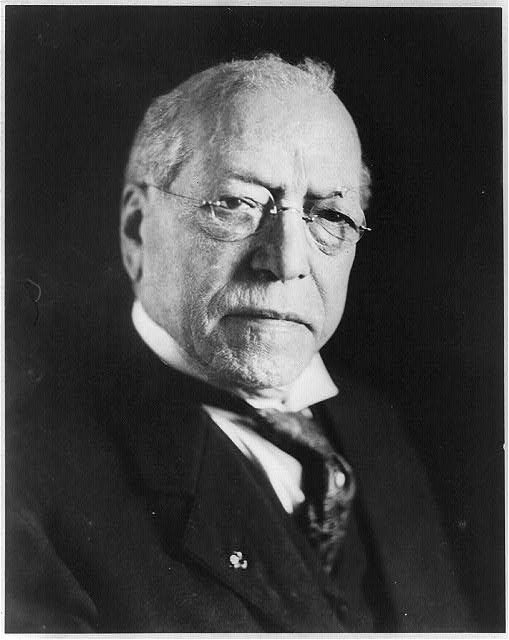
| American Federation of Labor (AFL) | A federation of skilled craft unions founded in 1886 by Samuel Gompers. Unlike the Knights of Labor, the AFL focused narrowly on ‘bread and butter’ issues — wages, hours, and working conditions — for skilled workers, and did not challenge capitalism itself. |
| Strike | A collective work stoppage by employees to pressure employers to improve wages, hours, or conditions. Strikes were the labor movement’s most powerful weapon but also its most dangerous, since striking workers could be fired, arrested, or physically attacked. |
| Homestead Strike (1892) | A violent labor conflict at Carnegie Steel’s Homestead, Pennsylvania plant, in which the company locked out union workers and hired Pinkerton detectives to break the union. A gun battle killed several workers and Pinkerton guards; the union was eventually destroyed, setting back steel unionization for decades. |
| Pullman Strike (1894) | A nationwide railroad strike led by Eugene Debs and the American Railway Union, triggered by wage cuts at the Pullman Palace Car Company. President Cleveland broke the strike by obtaining a federal court injunction and sending in the U.S. Army. |
| Injunction | A court order prohibiting a specific action. Courts in the Gilded Age regularly issued injunctions against strikes, declaring them illegal restraints of trade. Workers who defied injunctions could be jailed for contempt of court without a jury trial. |
Story and Historical Narrative
A. The World Workers Lived In
To understand why workers organized, you have to understand what their lives were actually like. A steelworker in Carnegie’s mills in the 1890s worked twelve-hour shifts, seven days a week, in conditions of extreme heat, noise, and danger. A coal miner went underground every day knowing that a gas explosion, a cave-in, or a runaway coal car could kill him without warning. A garment worker sat at a sewing machine in a sweatshop for sixty or seventy hours a week for wages that, if she was lucky, covered her rent and food.
Workers had virtually no legal protections. There were no minimum wage laws, no overtime requirements, no workplace safety regulations, no workers’ compensation for injuries, and no limits on child labor. The legal doctrine of ‘freedom of contract’ held that workers freely agreed to their conditions — ignoring the obvious reality that a worker who needed to eat had little meaningful freedom to refuse an employer’s terms.
When workers organized, employers had powerful tools to stop them. They could fire union organizers immediately. They could hire replacement workers — strikebreakers, called ‘scabs’ by union members. They could hire Pinkerton detectives, a private security force that specialized in infiltrating and breaking unions. And they could rely on courts that consistently sided with property rights over workers’ rights, and on governments — local, state, and federal — that were often willing to use troops against strikers.
B. The Knights of Labor
The first major national labor organization was the Knights of Labor, founded in Philadelphia in 1869. The Knights had an ambitious, almost utopian vision: they wanted to organize all workers — skilled and unskilled, men and women, Black and white (though racial inclusion was imperfect in practice) — into a single movement that would challenge the power of capital itself. They called for an eight-hour workday, equal pay for equal work regardless of sex, abolition of child labor, and worker ownership of factories and mines.
Analyze the impact of the labor movement in America throughout the 19th and 20th centuries.
The Knights grew dramatically in the early 1880s, reaching roughly 700,000 members by 1886. But they were fatally damaged by the Haymarket Affair that year. A labor rally in Chicago’s Haymarket Square turned violent when a bomb killed several police officers; additional deaths followed in the gunfire and panic. Although the Knights were not responsible for the bombing, the public increasingly associated labor radicalism with violence. Membership collapsed, and the organization never recovered.
C. The AFL: A Different Strategy
Samuel Gompers took a very different approach with the American Federation of Labor, which he founded in 1886. Gompers was a pragmatist. He had watched idealistic labor organizations destroyed by overreach and concluded that the only path to lasting gains was through patient, disciplined organizing of skilled workers in specific trades — carpenters, cigar makers, iron workers — focused on the practical goals of higher wages, shorter hours, and safer conditions.
The AFL did not challenge capitalism. It did not demand worker ownership of factories. It accepted the basic structure of the industrial economy and sought to improve workers’ share of what it produced. This ‘bread and butter’ unionism was criticized by radicals as too conservative — but it proved more durable than the Knights’ broader vision. The AFL remained the dominant force in American labor for fifty years.
D. The Great Strikes
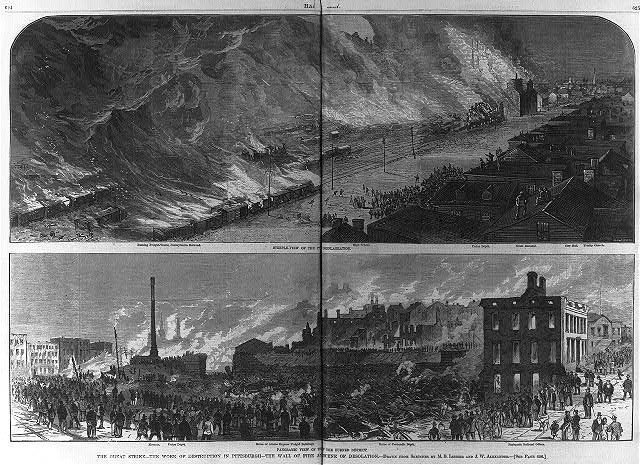
The Gilded Age produced some of the most dramatic labor conflicts in American history. The Great Railroad Strike of 1877 began when the Baltimore and Ohio Railroad cut wages for the second time in a year. Strikes spread spontaneously across the country; in Pittsburgh, workers seized the railroad yards and burned locomotives. President Hayes sent in federal troops, making the strike one of the first major examples of federal military intervention in a national labor conflict, and the strike was broken.
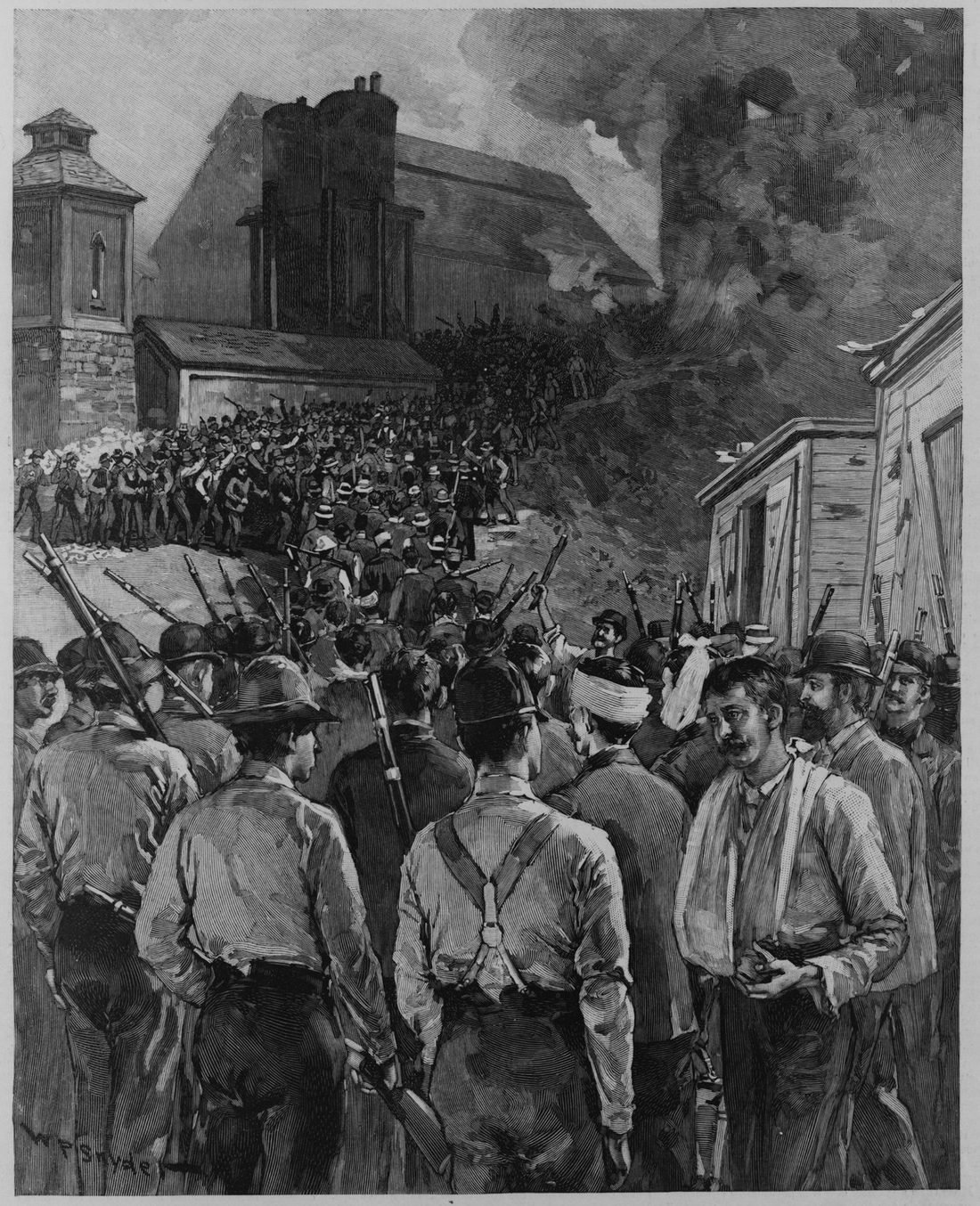
The Homestead Strike of 1892 pitted Carnegie Steel against the Amalgamated Association of Iron and Steel Workers. Carnegie’s manager Henry Clay Frick locked out the union workers and hired 300 Pinkerton detectives to protect replacement workers. When the Pinkertons arrived by barge on the Monongahela River, workers and their families met them with guns. Several workers and Pinkerton guards were killed in the resulting battle. The Pennsylvania governor eventually sent in the state militia; the union was crushed and Carnegie Steel remained non-union for decades.
The Pullman Strike of 1894 began at the company town where Pullman Palace Car workers lived as well as worked. When the company cut wages but not rents, Eugene Debs’s American Railway Union called a boycott that stopped railroad traffic nationwide. President Cleveland obtained a court injunction against the strike, then sent in the U.S. Army. Debs was arrested for contempt of court and sentenced to six months in prison — where he read socialist literature and emerged as the most famous socialist in American history.
Today’s Daily Dose short history film covers The Pullman Strike of 1894, which inspired Congress to create Labor Day. The filmmaker has included the original voice over script to further assist your understanding: Today on The Daily Dose, The Pullman Strike of 1894.
| WHY IT MATTERS TODAY | The labor conflicts of the Gilded Age eventually produced the legal framework that governs labor relations today — the Wagner Act (1935), the Fair Labor Standards Act (1938), the Occupational Safety and Health Act (1970). The eight-hour workday, the minimum wage, child labor laws, and workplace safety regulations were all won through decades of labor organizing and political struggle. Every workplace protection Americans take for granted today was fought for — often at great personal cost — by workers and unions in the era this lesson describes. |
Key Takeaways
- Gilded Age workers labored in dangerous conditions for low wages, with no legal protections and virtually no power against employers who could fire, blacklist, or call in troops against them.
- The Knights of Labor sought to organize all workers into a broad movement challenging capitalism itself; the Haymarket Affair destroyed their organization.
- The AFL took a pragmatic ‘bread and butter’ approach — organizing skilled workers in specific trades to win higher wages and shorter hours.
- Major strikes — the Great Railroad Strike (1877), Homestead (1892), Pullman (1894) — were almost always broken by a combination of employer power, court injunctions, and government troops.
- The labor movement’s Gilded Age struggles eventually produced the legal framework of worker protections — minimum wages, safety regulations, the right to organize — that Americans enjoy today.
Short Writing Assignment
Courts in the Gilded Age regularly used injunctions to stop strikes, calling them illegal ‘restraints of trade.’ In one to two paragraphs, explain why this legal approach was so devastating to the labor movement. What does it mean to call a strike a ‘restraint of trade’? Whose interests did this framing serve? And what does the courts’ willingness to jail strike leaders without a jury trial tell you about whose rights the legal system prioritized?
Extended Learning (Optional)
Expanded Writing Assignment
In 4–6 paragraphs, compare the Homestead Strike of 1892 and the Pullman Strike of 1894 as case studies in the limits of labor power in the Gilded Age. What caused each strike? What were the workers’ specific grievances? How did each employer respond? What role did government play in each? And what do both strikes together tell us about the balance of power between labor and capital in 1890s America?
Discussion Question
Eugene Debs was jailed for defying a court injunction against the Pullman Strike. He had not been convicted of any crime by a jury — he was imprisoned by a judge for contempt of court. Was this use of judicial power consistent with American constitutional principles? What does it tell us about the relationship between property rights and civil liberties in the Gilded Age? And does Debs deserve to be called a hero, a criminal, or something more complicated?
Primary Source Spotlight
“While there is a lower class I am in it; while there is a criminal element I am of it; while there is a soul in prison, I am not free.”
— Eugene V. Debs, statement at his sentencing for violating the Espionage Act, 1918
Debs said this years after the Pullman Strike, when he was sentenced to prison again — this time for opposing World War I. What does this statement tell you about how Debs understood his role in American society? How does it connect to what he experienced in the Pullman Strike? And do you think this kind of radical solidarity with the poor and imprisoned is admirable, dangerous, or both?
Explore Further
Read the Evidence
Preamble to the Knights of Labor Constitution and excerpts from Samuel Gompers on trade unionism.
Learn More
Melvyn Dubofsky, The State and Labor in Modern America – a scholarly overview of labor and government power.
Philip Dray, There Is Power in a Union – an accessible history of American labor.
Explore
Library of Congress labor-history collections on Homestead, Pullman, and the AFL.
Enroll in American History 102
This lesson is free to read. Enroll to unlock all 48 lessons, the quizzes, and your Certificate of Completion.
One Time
Get lifetime access to American History 102: Reconstruction to the Modern Era
for a single one-time payment.
- 48 self-paced lessons from Reconstruction to the 21st century
- A quiz with every lesson, plus a full final exam
- Exclusive “alternative perspectives” on pivotal moments other courses overlook
- Designed for high school, homeschool, and adult education
- Pay once — no subscriptions, no renewals