
Back to: AMERICAN HISTORY 102: CIVIL WAR RECONSTRUCTION TO PRESENT
UNIT II — THE CONSTITUTION IN PRACTICE AFTER THE CIVIL WAR
(Lessons 61–68)
Unit II examines what happened to the Reconstruction Amendments once the political will to enforce them collapsed. The unit begins by asking why the Constitution had to change so dramatically after the Civil War and then traces how the Supreme Court systematically narrowed those changes — limiting federal power, endorsing “separate but equal” in Plessy v. Ferguson, and allowing states to strip Black Americans of the voting rights the 15th Amendment had guaranteed. Students will wrestle with the gap between constitutional text and constitutional reality, exploring how the 14th Amendment’s equal protection clause was interpreted in ways its authors never intended — and how the process of incorporating the Bill of Rights against the states has slowly, unevenly, extended constitutional protections over the following century. The unit closes with the amendment process itself, asking how a constitutional democracy changes its own rules.
Lesson 61 – Why the Constitution Changed After the Civil War
| THEME | The Civil War revealed fundamental flaws in the original Constitution — flaws that had protected slavery, limited federal power, and left the rights of individuals to the mercy of their state governments. The Reconstruction Amendments were an attempt to fix those flaws permanently. |
Summary
The original Constitution of 1787 was a brilliant document — but it was also a document of compromises, and nowhere were those compromises more dangerous than on the question of slavery and the rights of individuals against their own state governments. The Civil War was, in many ways, the price the nation paid for those compromises.
The three Reconstruction Amendments — the 13th, 14th, and 15th — were not just policy responses to the war’s aftermath. They were a fundamental rethinking of what the Constitution was supposed to do: who it protected, what rights it guaranteed, and what role the federal government would play in enforcing those guarantees. Understanding why these amendments were necessary requires understanding the Constitution’s original design and its most glaring failures.
Visit Study.com for thousands more videos like this one. You’ll get full access to our interactive quizzes and transcripts and can find out how to use our videos to earn real college credit. YouTube hosts only the first few lessons in each course. The rest are at Study.com.
Learning Objectives
By the end of this lesson, you should be able to:
- Explain the key constitutional compromises that protected slavery in the original Constitution.
- Describe the limits on federal power that allowed states to abuse their residents’ rights.
- Explain how the Civil War changed Americans’ understanding of what the Constitution needed to do.
- Identify the three Reconstruction Amendments and the specific constitutional gaps each one addressed.
- Explain the concept of ‘constitutional revolution’ and why historians apply it to Reconstruction.
Visual Context
Source: Wikimedia Commons
Source: Wikimedia Commons
Source: Library of Congress
Key Vocabular
| Term | Definition |
|---|---|
| Three-Fifths Compromise | The provision in the original Constitution (Article I, Section 2) that counted enslaved people as three-fifths of a person for purposes of congressional representation and taxation — giving slaveholding states more political power without granting rights to the enslaved. |
| Fugitive Slave Clause | Article IV, Section 2 of the original Constitution, which required that people ‘held to service’ who escaped to free states must be returned to their owners — giving slavery constitutional protection across all states. |
| Reconstruction Amendments | The 13th, 14th, and 15th Amendments, ratified between 1865 and 1870, which abolished slavery, established citizenship and equal protection, and guaranteed voting rights regardless of race. Together they fundamentally reshaped the Constitution. |
| Federalism | The division of power between the federal (national) government and the states. The original Constitution gave states broad power over their residents’ daily lives. The Reconstruction Amendments shifted significant power toward the federal government to protect individual rights. |
| Constitutional revolution | A term historians use to describe the Reconstruction Amendments — arguing that they so fundamentally changed the nature of the Constitution that they amounted to a second founding of the American republic. |
| Supremacy Clause | Article VI of the Constitution, which declares that the Constitution and federal laws are the ‘supreme law of the land,’ overriding conflicting state laws. The Reconstruction Amendments dramatically expanded what federal supremacy meant in practice. |
Story and Historical Narrative
A. The Constitution’s Original Compromises on Slavery
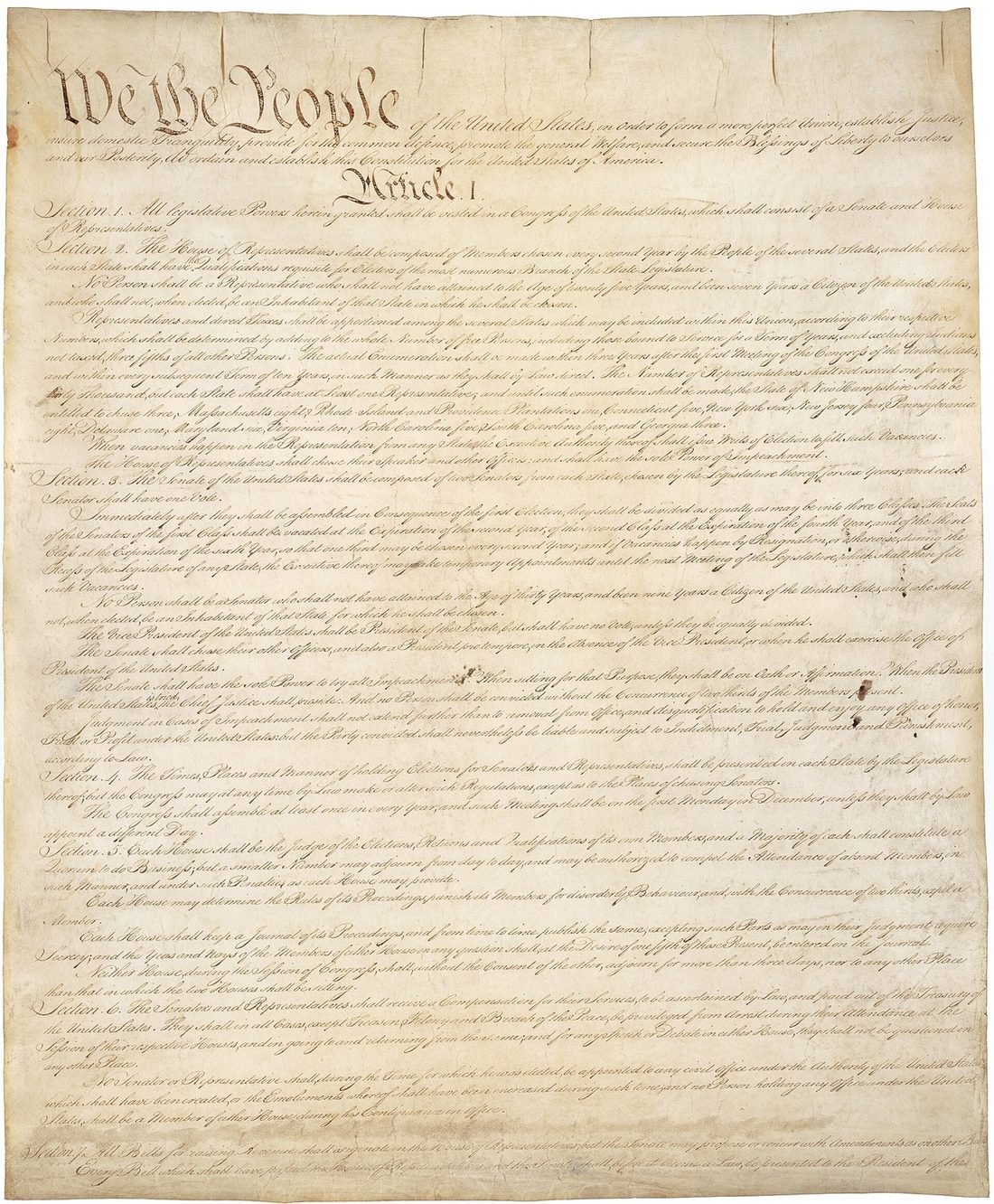
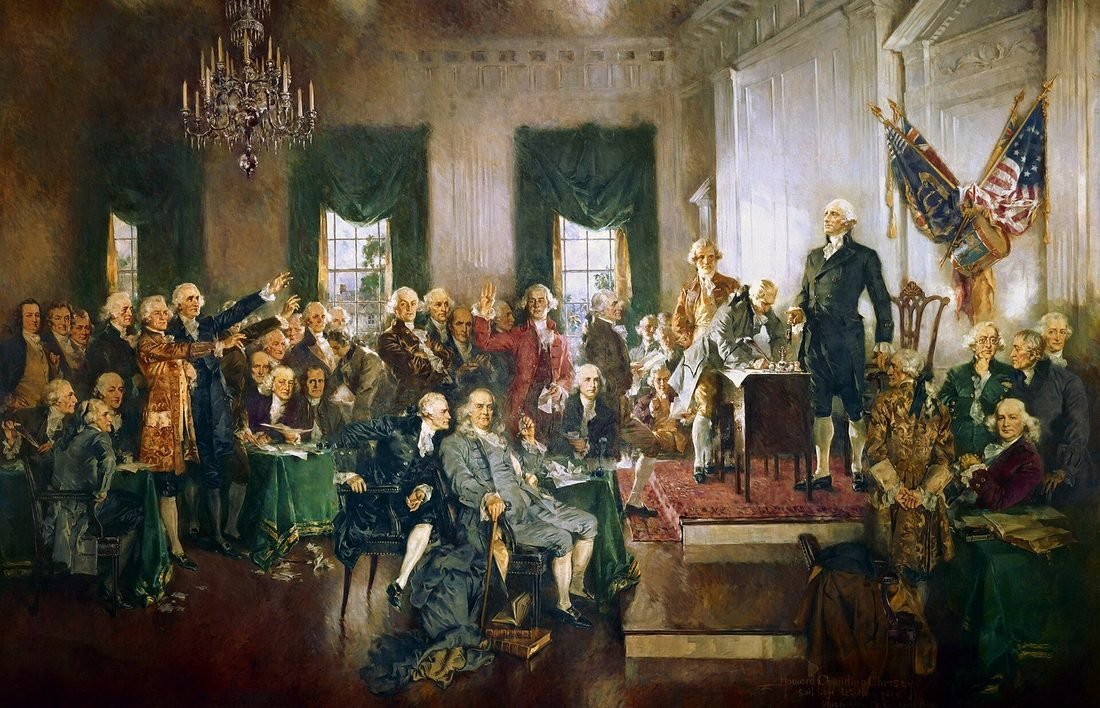
The men who wrote the Constitution in 1787 faced a problem they could not fully solve: several Southern states would not join a union that directly threatened slavery, while many Northern delegates were unwilling to give slavery explicit permanent protection in the founding document. The result was a series of compromises that protected slavery while largely avoiding the word itself.
The Three-Fifths Compromise gave slaveholding states extra representation in Congress by counting enslaved people as three-fifths of a person for apportionment purposes — even though those people had no political rights at all. The Fugitive Slave Clause required free states to return people escaping from bondage. Congress was barred from prohibiting the international slave trade before 1808, and the difficulty of constitutional amendment made major change nearly impossible without broad support, including support from states where slavery was deeply entrenched.
Is racism enshrined in the United States Constitution? How could the same Founding Fathers who endorsed the idea that all men are created equal also endorse the idea that some men are not?
These compromises gave slavery a constitutional foundation — not just in the South, but in the entire structure of American government. They gave slaveholding states disproportionate power in Congress and in the Electoral College, and they made the federal government complicit in the maintenance of slavery as an institution.
B. The Bill of Rights and Its Limits
The Bill of Rights, added to the Constitution in 1791, protected individuals from abuses by the federal government — but, as originally understood, not from abuses by their state governments. In 1833, the Supreme Court ruled in Barron v. Baltimore that the Bill of Rights applied only to the federal government. States had their own constitutions and legal traditions, but the federal Bill of Rights did not yet operate as a national restraint on state power.
For most Americans in most situations, this was not a pressing problem. But for enslaved people in the South, and for free Black Americans, the absence of federal protection against state abuse was catastrophic. Southern states could deny Black Americans any legal rights, and the federal government had no constitutional authority to intervene.
This gap — between what the Constitution promised and what states could do to their own residents — was one of the most fundamental flaws the Reconstruction Amendments were designed to fix.
C. How the War Changed Everything
The Civil War forced a reckoning with what the Constitution actually meant. When it ended, the victorious Republican Congress faced a choice: they could restore the union on the old constitutional terms — with states retaining broad power and the federal government playing a limited role — or they could use the constitutional amendment process to fundamentally restructure the relationship between the federal government, the states, and individual Americans.
They chose the second path. The Reconstruction Amendments were the result — and they represented a genuine constitutional revolution. For the first time, the Constitution directly addressed slavery (banning it), directly defined citizenship (guaranteeing it to all born on American soil), directly restricted what states could do to their own residents (requiring equal protection and due process), and directly prohibited a specific form of discrimination (in voting rights).
D. The Three Amendments and What Each Fixed
The 13th Amendment (1865) addressed the Constitution’s most glaring failure: it had never directly abolished slavery. The Emancipation Proclamation was a war measure; the 13th Amendment made abolition permanent and universal.
The 14th Amendment (1868) answered Dred Scott by defining national and state citizenship broadly, and it created the constitutional path by which federal courts would later apply many rights against the states. It required states to provide equal protection and due process, and gave Congress power to enforce these requirements through legislation. It transformed the federal government from a bystander in many state-rights disputes into a potential guarantor of individual rights.
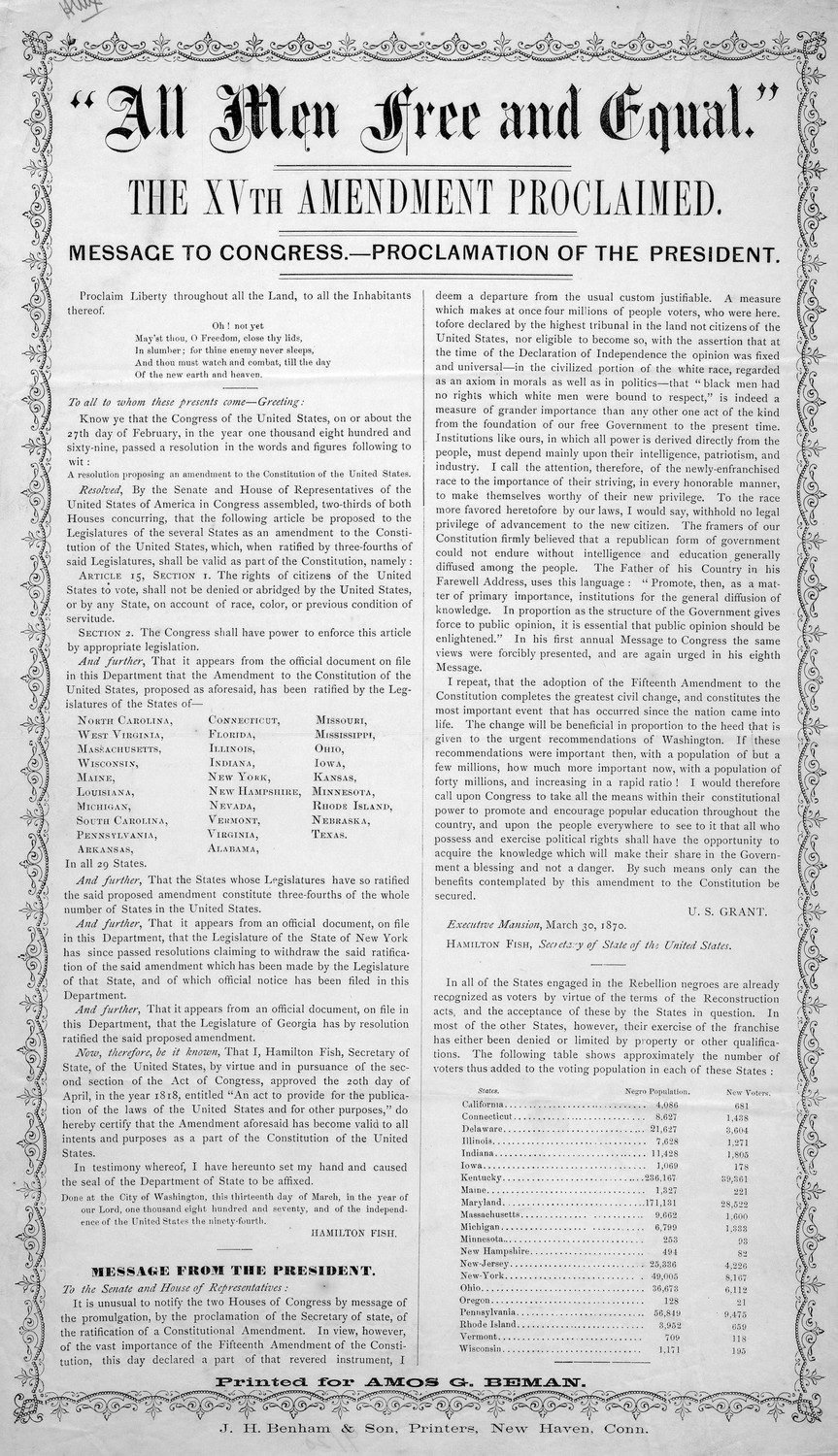
The 15th Amendment (1870) addressed voting rights — the most politically charged issue of Reconstruction. By prohibiting denial of the vote on account of race, it took the first step toward making Black men full political participants in American democracy, though as we have seen, its narrow language left enormous room for evasion.
E. A Second Founding?
Some historians argue that the Reconstruction Amendments were so significant that they amounted to a ‘second founding’ of the American republic — a moment when the nation remade its fundamental law to reflect values it had proclaimed but not yet lived up to. Others argue this overstates the case: the original Constitution remained in place, and the amendments were additions, not replacements.
What is clear is that the Reconstruction Amendments changed what the Constitution was fundamentally about. Before them, the Constitution was primarily a framework for organizing government and distributing power between the federal and state levels. After them, it was also more clearly a document of individual rights — rights that the federal government could be called upon to protect when state governments violated them. That shift, imperfectly realized in practice, is one of the most consequential changes in American constitutional history.
| WHY IT MATTERS TODAY | Every time a federal court strikes down a state law as a violation of individual rights — whether a school segregation law, a voting restriction, or a ban on same-sex marriage — it is using the constitutional framework established by the Reconstruction Amendments. The idea that the federal government exists partly to protect individuals against their own state governments is not in the original Constitution. It is the legacy of Reconstruction. |
Key Takeaways
- The original Constitution protected slavery through the Three-Fifths Compromise, the Fugitive Slave Clause, and the slave trade protection — without ever using the word ‘slavery.’
- The Bill of Rights originally protected individuals only from the federal government, not from state governments — leaving an enormous gap in constitutional protection.
- The Civil War created the political opportunity to fix these flaws through constitutional amendments — the 13th, 14th, and 15th Amendments.
- Together, the Reconstruction Amendments abolished slavery, defined citizenship, required equal protection and due process, and protected voting rights from racial discrimination.
- The Reconstruction Amendments fundamentally changed what the Constitution was: from primarily a framework for organizing government to also a document guaranteeing individual rights against state abuse.
Short Writing Assignment
In one to two paragraphs, explain why the Three-Fifths Compromise was a moral and political problem — not just for enslaved people, but for the entire constitutional system. How did giving slaveholding states extra representation in Congress based on people who had no rights distort American democracy? What does this tell you about the limits of compromise when fundamental rights are at stake?
Extended Learning (Optional)
Expanded Writing Assignment
Some historians argue the Founders were hypocrites who failed to live up to their own stated ideals of liberty and equality. Others argue they were practical men who made the best deal possible in 1787 and that abolishing slavery then would have made the union impossible. In 4–6 paragraphs, evaluate both arguments. What did the Founders get right? Where did they fail? And what does the fact that it took a civil war to fix their failures tell us about constitutional design?
Discussion Question
The Constitution was amended three times in five years during Reconstruction — more fundamental changes than in any comparable period before or since. What made this possible? What conditions — political, military, moral — were necessary to achieve this? And what does the fact that it took a catastrophic war to produce these amendments tell us about the pace of constitutional change in America?
Primary Source Spotlight
“We the people of the United States, in order to form a more perfect union, establish justice, insure domestic tranquility, provide for the common defense, promote the general welfare, and secure the blessings of liberty to ourselves and our posterity, do ordain and establish this Constitution for the United States of America.”
— Preamble to the U.S. Constitution, 1787
The Preamble promises justice and liberty — but the Constitution that followed protected slavery. In what sense did the Reconstruction Amendments complete the promise of the Preamble? In what sense did they fall short? What would a Constitution that truly ‘secured the blessings of liberty’ for all Americans have required?
Explore Further
Read the Evidence
The Constitution of the United States — especially the original slavery-related clauses and the 13th, 14th, and 15th Amendments.
Learn More
Eric Foner, The Second Founding: How the Civil War and Reconstruction Remade the Constitution — a clear, concise account of the Reconstruction Amendments.
Explore
National Constitution Center — Reconstruction Amendments resources.
Enroll in American History 102
This lesson is free to read. Enroll to unlock all 48 lessons, the quizzes, and your Certificate of Completion.
One Time
Get lifetime access to American History 102: Reconstruction to the Modern Era
for a single one-time payment.
- 48 self-paced lessons from Reconstruction to the 21st century
- A quiz with every lesson, plus a full final exam
- Exclusive “alternative perspectives” on pivotal moments other courses overlook
- Designed for high school, homeschool, and adult education
- Pay once — no subscriptions, no renewals