
Back to: AMERICAN HISTORY 102: CIVIL WAR RECONSTRUCTION TO PRESENT
UNIT V — AMERICA BECOMES A WORLD POWER
(Lessons 83–88)
Unit V traces America’s emergence as a global power — and the domestic consequences of that transformation. It opens with the Spanish-American War and the debate over empire that followed, asking whether a republic founded on anti-colonial principles could justify acquiring colonies of its own. Students will then follow America’s reluctant entry into World War I, Woodrow Wilson’s idealistic vision for a postwar world order, and the Senate’s rejection of the League of Nations — a constitutional confrontation over the limits of presidential power in foreign affairs. The unit then turns inward to the 1920s: a decade of remarkable prosperity, cultural explosion, racial conflict, and constitutional tension, followed by the shattering economic collapse of the Great Depression. It closes with Franklin Roosevelt’s New Deal — the most dramatic expansion of federal power in American history — and the constitutional arguments it provoked that have never fully been resolved.
Lesson 83 – The Spanish-American War and America’s Overseas Expansion
| THEME | The Spanish-American War of 1898 lasted only 113 days — but it transformed the United States from a continental republic into a global empire almost overnight, triggering a profound debate about whether a republic founded on consent of the governed can justly rule peoples who have not consented. |
Summary
In April 1898 the United States declared war on Spain over Cuba’s struggle for independence. The war was driven by genuine humanitarian concern, strategic ambition, and the sensationalist journalism of William Randolph Hearst and Joseph Pulitzer. It was over in 113 days. The resulting peace ended Spanish rule in Cuba and transferred Puerto Rico, Guam, and the Philippines to the United States — making America an overseas imperial power almost overnight. Cuba became formally independent in 1902 but under heavy U.S. influence through the Platt Amendment.
The annexation of the Philippines triggered one of the most searching debates in American political history, as the Anti-Imperialist League argued that ruling peoples who had not consented betrayed the republic’s founding principles. The Philippine-American War that followed was far more brutal than the war with Spain and raised deeply uncomfortable questions about the gap between American ideals and American practice.
Learning Objectives
By the end of this lesson, you should be able to:
- Explain the causes of the Spanish-American War, including the role of yellow journalism.
- Describe the key military events of the war in Cuba and the Philippines.
- Explain what the United States gained from the Treaty of Paris of 1898.
- Describe the debate between imperialists and anti-imperialists over America’s overseas expansion.
- Explain the Philippine-American War and why it was more costly and controversial than the Spanish-American War.
Visual Context
Source: Library of Congress
Source: Library of Congress
Source: Library of Congress
Key Vocabulary
| Term | Definition |
|---|---|
| Yellow journalism | Sensationalist newspaper reporting that exaggerated or fabricated stories to sell papers and inflame public opinion. Hearst’s New York Journal and Pulitzer’s New York World competed to cover Cuba with lurid headlines that whipped up public anger at Spain. |
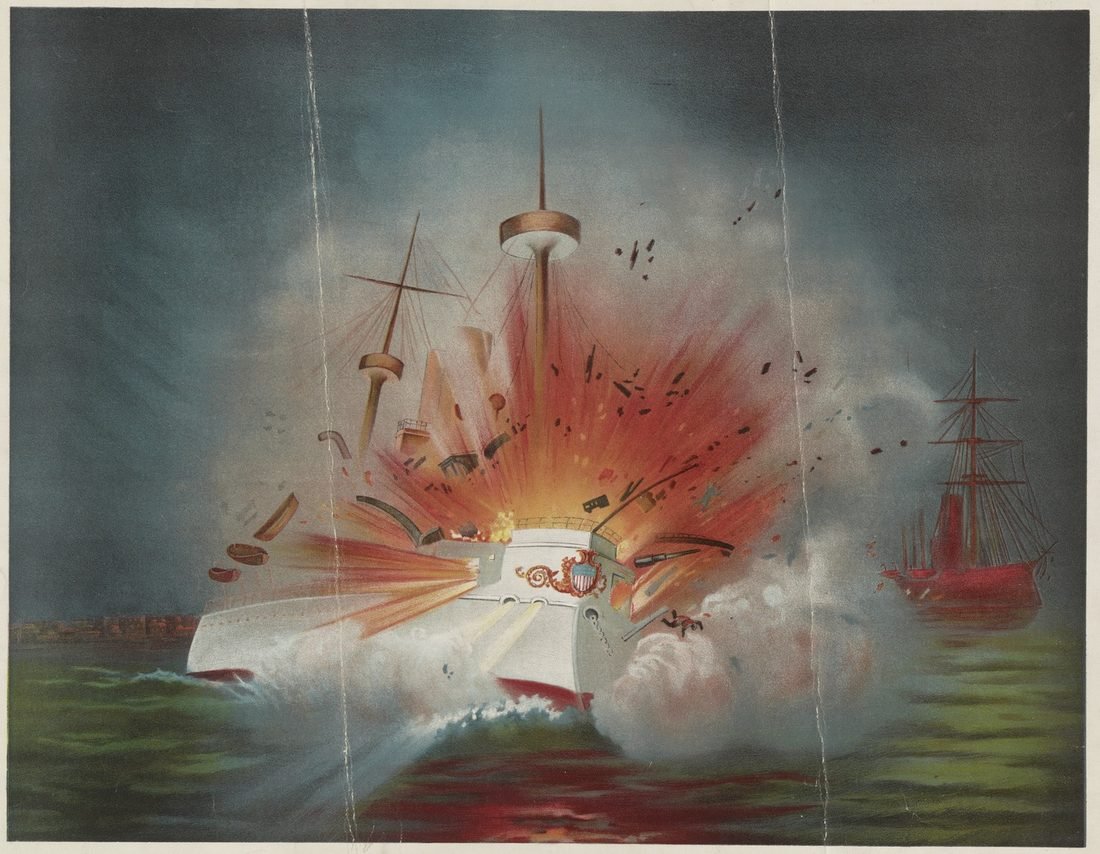
| USS Maine | An American battleship that exploded in Havana Harbor on February 15, 1898, killing 266 sailors. Later investigations have pointed toward an internal explosion rather than a Spanish attack, but the press blamed Spain, and ‘Remember the Maine!’ became the war’s rallying cry. |
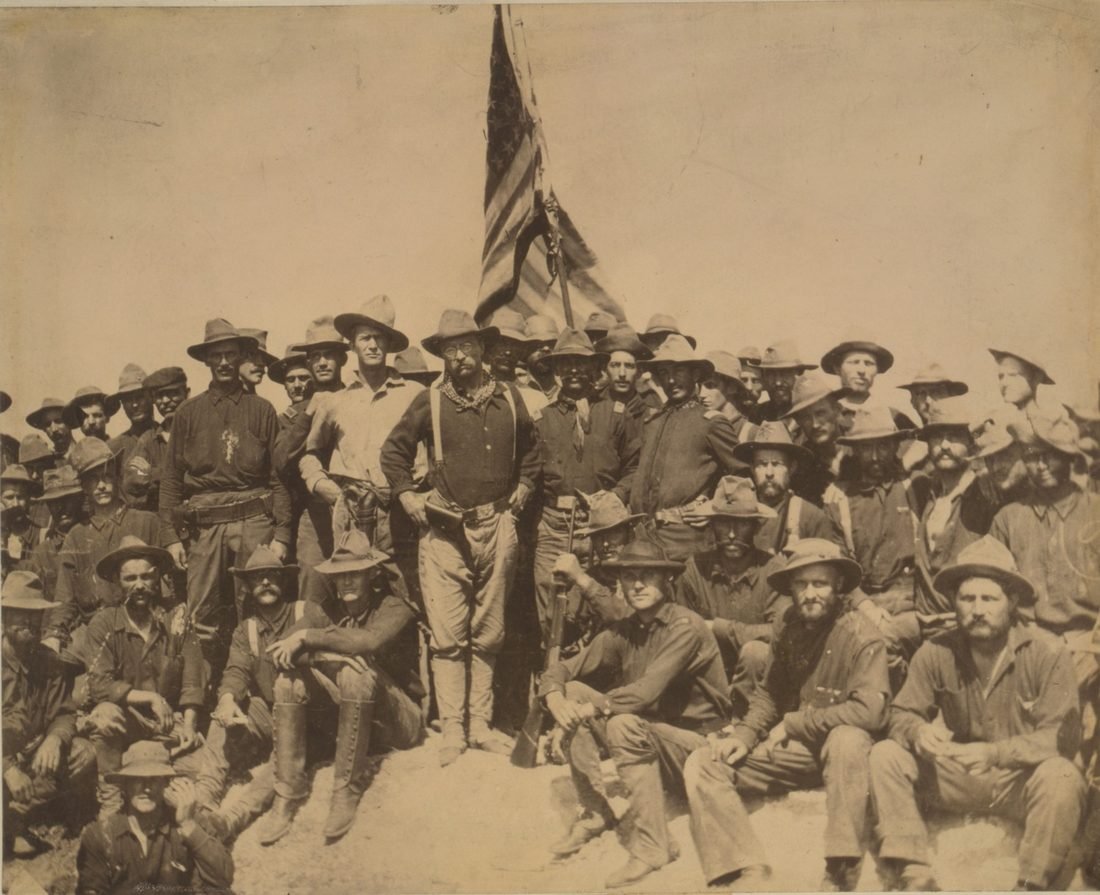
| Rough Riders | The 1st United States Volunteer Cavalry regiment led by Theodore Roosevelt, which gained national fame for charging up Kettle Hill during the Battle of Santiago in Cuba. |
| Treaty of Paris (1898) | The peace agreement ending the Spanish-American War, in which Spain relinquished sovereignty over Cuba and transferred Puerto Rico, Guam, and the Philippines to the United States; the United States paid Spain $20 million for the Philippines. |
| Anti-Imperialist League | An organization founded in 1898 to oppose annexation of the Philippines. Its members included Mark Twain, Andrew Carnegie, and former President Grover Cleveland, who argued that ruling peoples without their consent betrayed American democratic principles. |
| Philippine-American War | The conflict (1899–1902, with guerrilla resistance continuing until 1913) between the U.S. and Filipino independence fighters. Far more brutal than the war with Spain, it resulted in hundreds of thousands of Filipino deaths. |
Story and Historical Narrative
A. The Road to War
Cuba had been fighting for independence from Spain since 1895. Spanish General Valeriano Weyler’s policy of herding civilians into ‘reconcentration camps’ gave American newspapers a steady supply of outrage-generating material. William Randolph Hearst’s New York Journal and Joseph Pulitzer’s New York World competed furiously to outsell each other with increasingly dramatic accounts of Spanish brutality. The explosion of the USS Maine in Havana Harbor on February 15, 1898 provided the emotional trigger the war hawks needed. Public outrage overwhelmed President McKinley’s reluctance, and Congress declared war on April 25, 1898.
Shortly after an explosion sunk the battleship U.S.S. Maine in Havana harbor, Cuba, William Randolph Heart’s newspaper declared confidently: “MAINE DESTROYED BY SPANISH.” How could he know that? He didn’t.
B. The War
The war was remarkably swift and lopsided. On May 1, 1898 — just days after the declaration — Commodore George Dewey’s Asiatic Squadron sailed into Manila Bay in the Philippines and destroyed the Spanish fleet there in hours, without losing a single American sailor. In Cuba, Theodore Roosevelt and the Rough Riders gained fame in the assault on Kettle Hill during the broader fight for the San Juan Heights above Santiago on July 1, 1898. The armistice came in August — less than four months after the war began. Fewer than 400 Americans died in combat, though disease killed thousands more.
Teddy Roosevelt assembles a group of men in the First United States Volunteer Cavalry Regiment.
C. The Imperial Debate
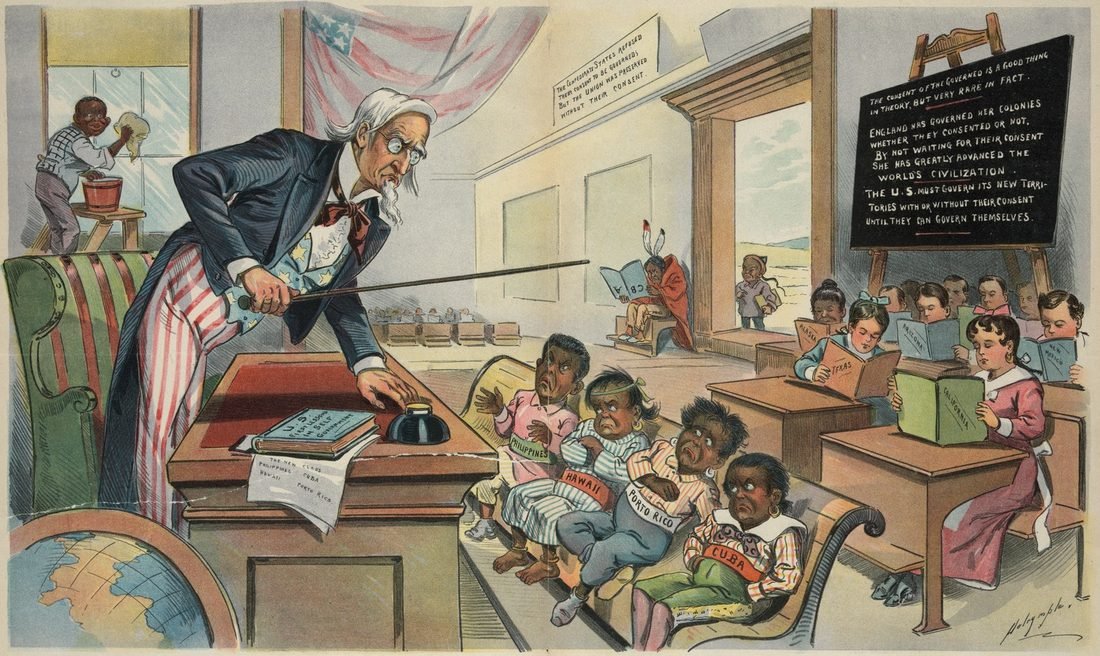
The Treaty of Paris ended Spanish sovereignty over Cuba and transferred Puerto Rico, Guam, and the Philippines to the United States. The Philippines acquisition ignited fierce debate. The Anti-Imperialist League — Mark Twain, Carnegie, Jane Addams, and former President Cleveland — argued that annexing the Philippines was a fundamental betrayal: a republic founded on consent of the governed cannot legitimately rule people who have not consented. Twain was scathing, suggesting the American flag should have ‘the white stripes painted black and the stars replaced by the skull and cross-bones.’
Imperialists countered that the Philippines were strategically vital for Pacific trade and naval power, that Filipinos were unready for self-government, and that another power would take the islands if the United States did not. President McKinley later reportedly told a Methodist delegation that he had concluded the United States should take the Philippines and ‘uplift and civilize and Christianize’ its people — a striking claim, especially because most Filipinos were already Catholic.
D. The Philippine-American War
The Filipinos had their own ideas. Emilio Aguinaldo had led resistance against Spain and expected American support for independence. When it became clear the United States intended to rule rather than free the Philippines, his forces turned against the Americans. The Philippine-American War was far more costly and brutal than the war with Spain. American forces used concentration camps and torture; Philippine civilian deaths from war, disease, and famine are commonly estimated in the hundreds of thousands, though exact figures remain debated. More than 4,000 American soldiers died.
E. The Legacy
The territories acquired in 1898 have had very different trajectories. Cuba’s history of American intervention shaped its politics through the 20th century. Puerto Rico remains an American territory today — its residents are American citizens but cannot vote for president and have no voting representation in Congress. The Philippines became independent in 1946. The questions raised by the anti-imperialists remain unresolved.
| WHY IT MATTERS TODAY | The 1898 acquisitions carry legacies that reach into the present. Puerto Rico’s unresolved status — American citizens without full political representation — continues to generate debate about self-determination and democracy. The broader question the anti-imperialists raised — whether a republic founded on consent can justly rule peoples who have not consented — recurs whenever the United States debates its role in the world. |
Key Takeaways
- The Spanish-American War was driven by Cuba’s independence struggle, yellow journalism, and strategic ambition — and lasted only 113 days.
- The Treaty of Paris ended Spanish rule in Cuba and gave the United States Puerto Rico, Guam, and the Philippines; Cuba became formally independent but under heavy U.S. influence.
- The Anti-Imperialist League argued that ruling conquered peoples without their consent betrayed American democratic principles.
- The Philippine-American War was far more brutal than the war with Spain, involving concentration camps, torture, and hundreds of thousands of Filipino deaths.
- The 1898 imperial debate raised questions about whether a republic founded on consent can justly rule peoples who have not consented — questions still unresolved today.
Short Writing Assignment
Mark Twain suggested the American flag should have its white stripes painted black and its stars replaced by the skull and cross-bones to reflect American conduct in the Philippines. In one to two paragraphs, explain what he meant. Do you think his critique was fair? And what does the gap between American rhetoric about freedom and democracy and American behavior in the Philippines tell us about the relationship between national ideals and imperial practice?
Extended Learning (Optional)
Expanded Writing Assignment
In 4–6 paragraphs, evaluate the debate between imperialists and anti-imperialists in 1898. What were the strongest arguments on each side? Which do you find more persuasive? And how does the subsequent history of the Philippines — the brutality of the Philippine-American War, the long period of American colonial rule, and eventual independence in 1946 — affect your evaluation of the imperialist position?
Discussion Question
Puerto Rico has been an American territory for more than 125 years. Its residents are American citizens but cannot vote for president and have no voting representation in Congress. What do you think the United States owes Puerto Rico after more than a century of territorial status? And what does Puerto Rico’s situation tell us about the ongoing legacy of 1898?
Primary Source Spotlight
“We cannot fly from our world duties; it is ours to execute the purpose of a fate that has driven us to be greater than our small intentions. We cannot retreat from any soil where Providence has unfurled our banner.”
— Senator Albert Beveridge, speech to the U.S. Senate, January 9, 1900
Beveridge argues that American expansion is divinely ordained and brings liberty to conquered peoples. How does this argument compare to what actually happened in the Philippines? What rhetorical moves does he make to frame conquest as altruism?
Explore Further
Read the Evidence
Treaty of Paris (1898), the Teller Amendment, and the Platt Amendment.
Learn More
Kristin L. Hoganson, Fighting for American Manhood.
Explore
Library of Congress collections on the Spanish-American War and U.S. imperialism.
The following presents a critical perspective on American overseas expansion in 1898, arguing that the acquisition of foreign territories represented an unjustified act of aggression rather than a legitimate exercise of national power.
A. Conquest Is Conquest — Whatever You Call It
The mainstream account presents the Spanish-American War as a humanitarian intervention on behalf of Cuba, with the acquisition of overseas territories as an incidental byproduct. The alternate perspective calls this what it is: conquest. The United States used military force to seize territories whose peoples had not been consulted and did not consent to American rule. Dressing this up in the language of ‘civilization’ and ‘uplift’ does not change the underlying reality.
From this perspective, there is no adequate justification for acquiring Puerto Rico, Guam, and the Philippines without the consent of the people who lived there. The fact that Spain had mistreated these peoples did not give the United States the right to replace Spanish rule with American rule. If the genuine goal was freedom for the Cuban people, the United States could have recognized Cuban independence and gone home. Instead, it built an empire.
B. Roosevelt the Expansionist vs. Cleveland the Constitutionalist
It is worth noting that not all American presidents of this era supported overseas expansion. Grover Cleveland — who served two terms as president before McKinley — was a principled opponent of imperialism. When expansionists tried to push the annexation of Hawaii in the 1890s, Cleveland refused, arguing it would be an act of aggressive policy contrary to American traditions of self-government. He was ridiculed by the expansionists for this position.
Theodore Roosevelt was the opposite: a passionate expansionist who believed in American greatness through military power and territorial acquisition. The difference between Cleveland and Roosevelt illustrates that imperialism was a political choice, not an inevitable outcome. The United States did not have to become an empire in 1898. It chose to.
C. The Anti-Imperialists Were Right
The Anti-Imperialist League — which included Mark Twain, Andrew Carnegie, and former President Grover Cleveland — argued at the time that American imperialism betrayed the republic’s founding principles. A nation founded on the consent of the governed cannot justly rule over peoples who have not consented. This argument was dismissed at the time and remains underrepresented in standard historical accounts.
Looking at the consequences — the brutal Philippine-American War, the long occupation of Puerto Rico (whose residents are still not full political participants in American democracy more than 125 years later), the pattern of interventions in Cuba and Latin America that followed — the anti-imperialists appear to have been right about what empire would cost, both morally and practically.
The question of whether American overseas expansion in 1898 was justified is not merely academic. Puerto Rico remains an American territory today, and the debate about its status — statehood, independence, or continued territorial status — is a direct consequence of decisions made in 1898. Students should consider: does a nation that justifies itself on the consent of the governed have the right to acquire and hold territories whose people did not choose to be governed by it?
Liberty Tree University Resources
Videos, readings, and practice activities.
Click a title to open it.
The Theft of the Hawaiian Islands
Enroll in American History 102
This lesson is free to read. Enroll to unlock all 48 lessons, the quizzes, and your Certificate of Completion.
One Time
Get lifetime access to American History 102: Reconstruction to the Modern Era
for a single one-time payment.
- 48 self-paced lessons from Reconstruction to the 21st century
- A quiz with every lesson, plus a full final exam
- Exclusive “alternative perspectives” on pivotal moments other courses overlook
- Designed for high school, homeschool, and adult education
- Pay once — no subscriptions, no renewals