
Back to: AMERICAN HISTORY 102: CIVIL WAR RECONSTRUCTION TO PRESENT
Lesson 88 – Franklin Roosevelt, the New Deal, and the Growth of Federal Power
| THEME | Franklin Roosevelt’s New Deal was the most dramatic expansion of federal government power in American history. It did not end the Depression — World War II did that — but it permanently transformed the relationship between the federal government and ordinary Americans. |
Summary
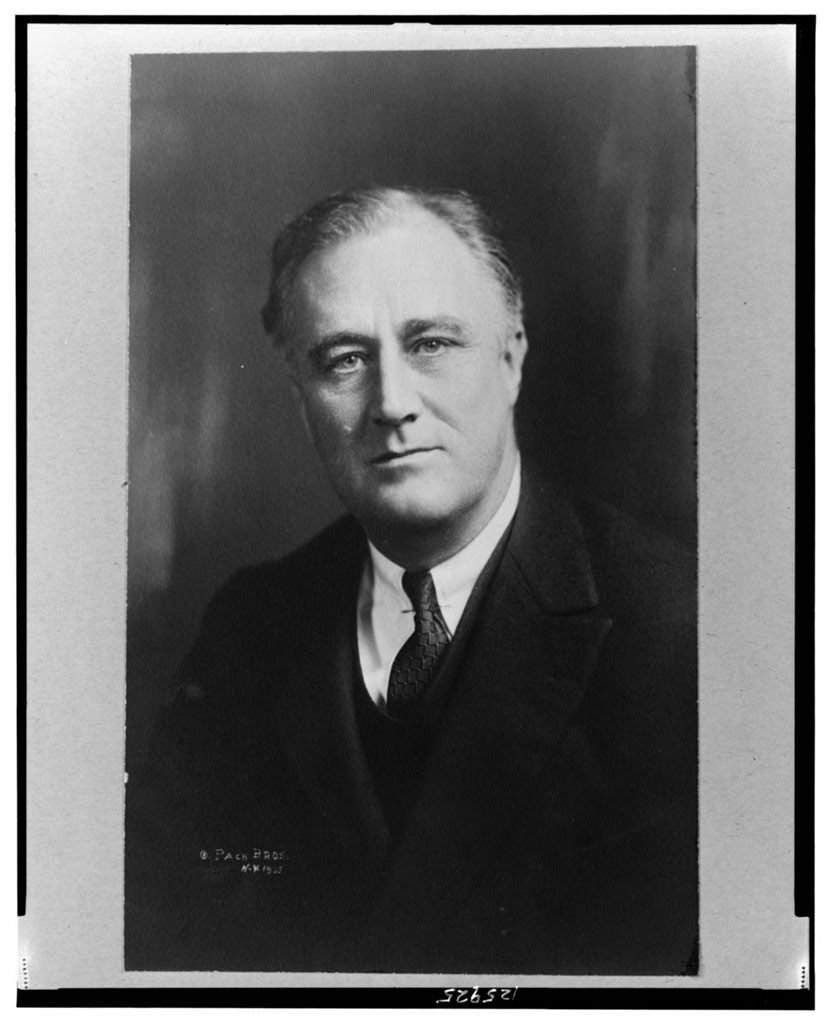
Franklin Delano Roosevelt was elected in a landslide in November 1932, carrying 42 of 48 states on a promise of ‘a new deal for the American people.’ His first hundred days in office produced a remarkable burst of legislation that stabilized the banking system, provided emergency relief, and began the long work of economic recovery.
As always, the Federalist Society takes no position on particular legal or public policy issues; all expressions of opinion are those of the speaker.
The New Deal transformed American government. It created Social Security, established the right of workers to organize unions, regulated the banking and securities industries, and put millions of unemployed Americans to work. It did not end the Depression — unemployment was still above 14% in 1940 — but it restored hope, stabilized democratic institutions, and permanently expanded the federal government’s role in American economic life.
Learning Objectives
By the end of this lesson, you should be able to:
- Describe Roosevelt’s philosophy and explain what made his approach different from Hoover’s.
- Explain the key programs of the First New Deal (1933–1934) and the problems each addressed.
- Explain the key programs of the Second New Deal (1935–1936) and their lasting significance.
- Describe the Supreme Court’s conflict with the New Deal and Roosevelt’s court-packing plan.
- Analyze the New Deal’s long-term impact on American government and society.
Visual Context
Source: Library of Congress
Source: National Archives
Source: Wikimedia Commons
Key Vocabulary
| Term | Definition |
|---|---|
| New Deal | Franklin Roosevelt’s broad program of relief, recovery, and reform enacted during the 1930s. It dramatically expanded federal government power and created lasting institutions — Social Security, the FDIC, the SEC, the NLRB. |
| First Hundred Days | The extraordinarily productive opening period of Roosevelt’s presidency (March–June 1933) in which Congress passed fifteen major pieces of legislation. |
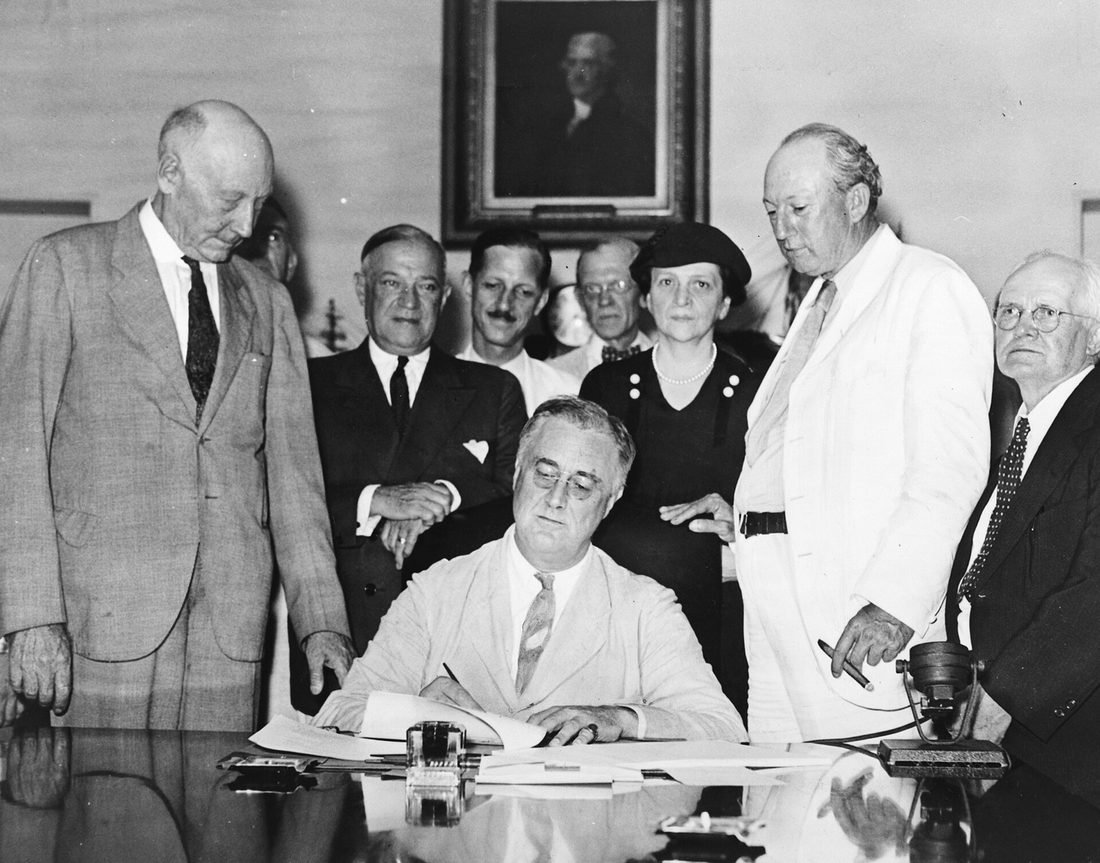
| Social Security Act (1935) | Landmark legislation creating a federal program of retirement benefits for workers over 65, funded by payroll taxes. Expanded over time to include disability insurance and survivors’ benefits. |
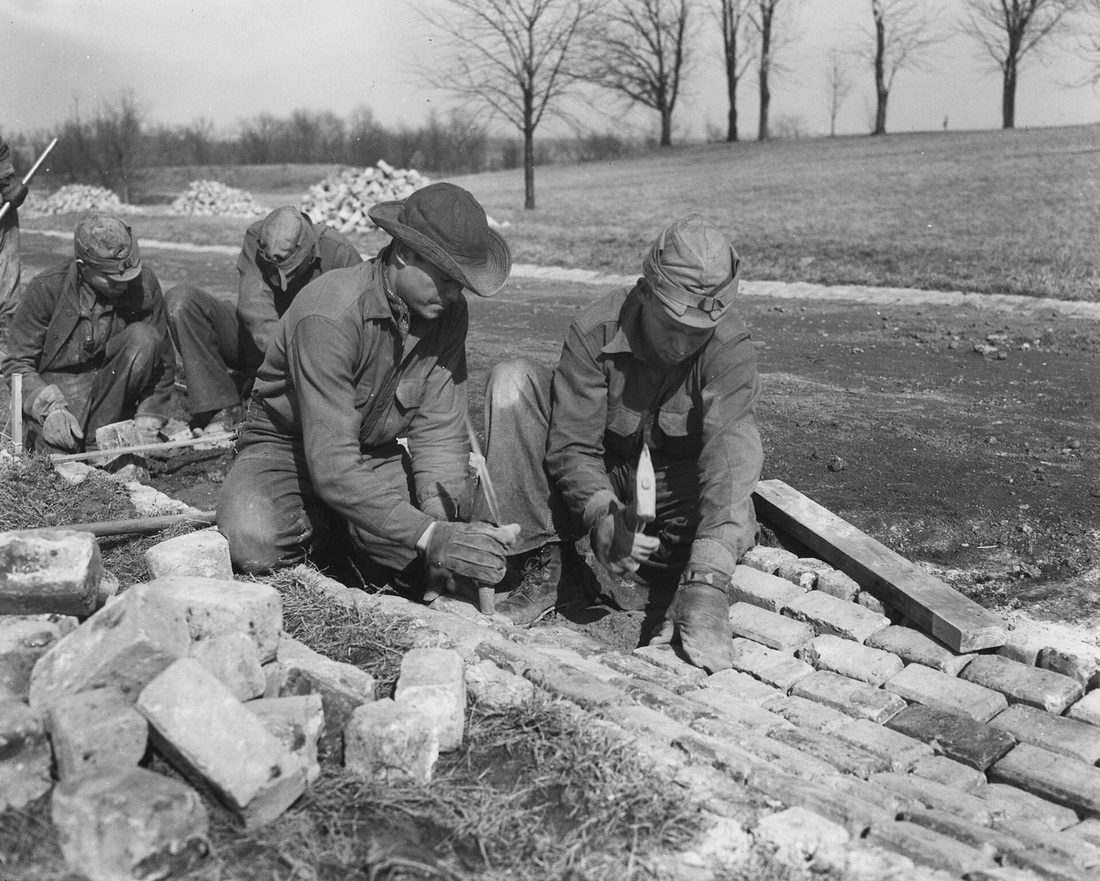
| Civilian Conservation Corps (CCC) | A New Deal work relief program (1933–1942) that employed about three million young men in conservation projects. |
| Works Progress Administration (WPA) | The largest New Deal employment program, which between 1935 and 1943 employed over 8 million workers in construction, arts, and public projects. |
| Court-packing plan | Roosevelt’s 1937 proposal to add up to six new justices to the Supreme Court after it struck down several New Deal programs. Congress rejected the plan, but the Court soon reversed course — ‘the switch in time that saved nine.’ |
Story and Historical Narrative
A. Roosevelt Takes Command
Franklin Roosevelt was inaugurated on March 4, 1933, with unemployment at 25% and the banking system in collapse. His inaugural address struck a tone of confident action: ‘The only thing we have to fear is fear itself.’ Roosevelt was not an ideologue — he had no fixed economic theory. What he had was unshakable optimism, willingness to experiment, and a genuine feeling for the suffering of ordinary people. His weekly radio ‘fireside chats’ restored public confidence in ways that no amount of policy alone could have done.
B. The First New Deal
Within days of taking office, Roosevelt declared a bank holiday and pushed through the Emergency Banking Act, which allowed sound banks to reopen under federal supervision. The Glass-Steagall Act created the Federal Deposit Insurance Corporation (FDIC). The Agricultural Adjustment Act paid farmers to reduce production. The National Industrial Recovery Act included Section 7(a), guaranteeing workers the right to organize unions. The Civilian Conservation Corps put 250,000 young men to work in national parks within months.
C. The Second New Deal
By 1935, the emergency had stabilized but the economy had not recovered. The Social Security Act (1935) created a federal retirement insurance program for workers. The National Labor Relations Act (Wagner Act, 1935) guaranteed workers the right to organize, bargain collectively, and strike. The Works Progress Administration employed over 8 million Americans in everything from road construction to theater productions.
Explore how the Great Depression of the 1930s forced America to consider having a social safety net, leading President FDR to sign the Social Security Act into law via his New Deal programs. Learn how Social Security has changed over time.
D. The Supreme Court Battle
The Supreme Court struck down key New Deal programs in 1935–1936. After his landslide re-election, Roosevelt proposed his ‘court-packing plan’ — adding one new justice for every sitting justice over age 70, potentially adding six new members. Congress ultimately rejected it. But the Court soon reversed course in a series of 1937 decisions, upholding New Deal programs — ‘the switch in time that saved nine.’
President Roosevelt’s attempt to reshape the Supreme Court landed short and drew criticism from both Republicans and Democrats. “It was a recognition on his part that he had lost some measure of power,” says David Ginsburg, a member of FDR’s administration.
E. What the New Deal Did — and Didn’t Do
The New Deal did not end the Depression. Unemployment was still above 14% in 1940. What ended the Depression was World War II — the enormous federal spending required for mobilization finally pushed the economy to full employment. What the New Deal did was transform American government permanently: establishing that the federal government had a responsibility to protect citizens from economic catastrophe, and creating the institutional framework of the modern welfare state.
| WHY IT MATTERS TODAY | The New Deal created most of the institutions of modern American government that people interact with daily — Social Security, the FDIC, the SEC, the NLRB, and unemployment insurance. The debate over the New Deal — whether it helped or hindered recovery, whether it expanded government too far — continues to shape American political debate about the proper role of government in economic life. |
Key Takeaways
- Roosevelt’s New Deal was defined by experimentation, action, and a belief that the federal government had a responsibility to protect ordinary citizens from economic catastrophe.
- The First New Deal stabilized the banking system, provided agricultural relief, guaranteed labor rights, and put unemployed Americans to work.
- The Second New Deal produced the most enduring legislation: Social Security, the Wagner Act, and the WPA.
- Roosevelt’s court-packing plan was rejected, but the Court reversed course — ‘the switch in time that saved nine.’
- The New Deal did not end the Depression — World War II did — but it permanently transformed American government and restored confidence in democratic institutions.
Short Writing Assignment
Roosevelt said ‘the only thing we have to fear is fear itself.’ In one to two paragraphs, explain what he meant by this. How does psychology — confidence, trust, expectation — affect economic behavior? And what does Roosevelt’s ability to restore public confidence tell us about the importance of leadership in a crisis?
Extended Learning (Optional)
Expanded Writing Assignment
In 4–6 paragraphs, evaluate the New Deal as a response to the Great Depression. What did it accomplish? Where did it fall short? Was it too ambitious — expanding government beyond its proper role — or not ambitious enough? Consider whose perspective you are adopting: an unemployed white worker in Ohio, a Black sharecropper in Alabama, a wealthy banker in New York.
Discussion Question
The New Deal largely excluded Black Americans and women from many of its programs — the result of political compromises with Southern Democrats. Was this an acceptable pragmatic compromise — better to pass imperfect legislation than nothing — or a fundamental moral failure? How should we evaluate political compromises that achieve important goals by sacrificing the rights of some groups?
Primary Source Spotlight
“This generation of Americans has a rendezvous with destiny. We are fighting to save a great and precious form of government for ourselves and for the world.”
— Franklin D. Roosevelt, Democratic National Convention, June 27, 1936
Roosevelt frames the New Deal as a battle to save democratic government itself. Why did he frame it this way? What was at stake for democracy — in the United States and globally — if the Depression continued without an effective response?
Explore Further
Read the Evidence
Social Security Act (1935) excerpts.
Franklin D. Roosevelt, 1936 Democratic National Convention Address.
Learn More
William E. Leuchtenburg, Franklin D. Roosevelt and the New Deal.
Ira Katznelson, Fear Itself.
Explore
Social Security Administration history pages and FDR Presidential Library New Deal exhibits.
The following presents a critical perspective on Franklin Roosevelt, the New Deal, and World War II. It argues that the New Deal did not end the Depression — wartime mobilization did — and asks whether Roosevelt’s policies toward Japan made war more likely. Claims that Roosevelt deliberately allowed Pearl Harbor to happen are highly contested and not accepted by mainstream historians; students should evaluate them carefully against the evidence.
A. War Ended the Depression — Not the New Deal
The main lesson acknowledges that the New Deal did not end the Great Depression — unemployment remained high in 1940 and World War II mobilization finally achieved full employment. The alternate perspective emphasizes the uncomfortable implication: massive federal borrowing and wartime production accomplished what New Deal programs had not. That does not prove war was desired for economic reasons, but it does raise questions about the relationship between government debt, industrial production, and economic recovery.
Wartime spending — funded by massive government borrowing and supported by Federal Reserve policy — created demand on a scale the New Deal never reached. Banks, defense contractors, and industries tied to military production benefited enormously. Critics from Smedley Butler onward have argued that wars often enrich financial and industrial interests even when ordinary citizens bear the costs. This is a legitimate line of inquiry, but it should not be treated as proof that war was deliberately engineered.
B. Roosevelt’s Provocation of Japan
The mainstream account presents Pearl Harbor as a Japanese attack that shocked the American public and ended the debate over U.S. entry into World War II. The alternate perspective argues that Roosevelt’s increasingly severe pressure on Japan — especially the oil embargo — made conflict more likely, even if it does not prove he intended or welcomed the specific attack on Pearl Harbor.
The sequence of events is documented: in July 1941 the United States froze Japanese assets and effectively cut off Japan’s access to American oil, on which Japan heavily depended. Japanese military planners saw this as a strategic crisis. They could accept American demands and retreat from much of their expansion in Asia, or they could seize oil supplies in Southeast Asia — a move that risked war with the United States, Britain, and the Netherlands. Pearl Harbor was Japan’s attempt to cripple the U.S. Pacific Fleet long enough to secure those conquests.
Critics argue that Roosevelt understood the oil embargo might provoke war and accepted that risk because he believed Axis victory would be disastrous. That is different from proving that he knew the time and place of the Pearl Harbor attack or deliberately sacrificed American lives. Students should keep those claims distinct.
C. Pearl Harbor: What Did Roosevelt Know?
The most controversial element of this alternate perspective is the claim that Roosevelt had specific foreknowledge of the Pearl Harbor attack and failed to prevent it. Mainstream historians generally reject that conclusion. A more defensible criticism is that Washington possessed warning signs and intelligence fragments that were not properly shared or interpreted, and that failures of communication and judgment contributed to the disaster.
Evidence cited in this debate includes the fact that American cryptographers had broken important Japanese diplomatic codes; Washington received warnings that war with Japan was increasingly likely; and commanders in Hawaii did not receive all the intelligence and context available in Washington. These facts support criticism of intelligence handling. They do not, by themselves, prove that Roosevelt knew Pearl Harbor would be attacked on December 7.
It is important to note that the mainstream account — including the Summers and Swan book A Matter of Honor (2016) cited below — does not support the conclusion that Roosevelt deliberately allowed the attack. That book argues that Kimmel was wrongly scapegoated and that intelligence failures in Washington contributed to the disaster, but it clears Roosevelt of the charge of foreknowledge. Students should read both the critical perspective and the mainstream account carefully before drawing conclusions.
D. Admiral Kimmel: The Man Who Took the Fall
Whatever one concludes about Roosevelt’s foreknowledge, the case of Admiral Husband Kimmel raises serious questions about accountability and justice. Kimmel commanded the Pacific Fleet at Pearl Harbor. In the aftermath of the attack, he was relieved of command, accused of dereliction of duty, and publicly disgraced. He spent the rest of his life fighting to clear his name. After his death, his sons — both Navy veterans — continued the fight. Both houses of Congress approved the posthumous restoration of Kimmel’s four-star rank, only to be blocked by the Navy bureaucracy.
It is well documented that intelligence about Japanese intentions and the likelihood of war was available in Washington and was not adequately conveyed to Kimmel and Short. Whether this was bureaucratic failure, poor judgment, or something more deliberate remains debated. What is not seriously disputed is that the commanders in Hawaii were punished for failures that were not theirs alone.
E. Suggested Reading
- A Matter of Honor: Pearl Harbor — Betrayal, Blame, and a Family’s Quest for Justice by Anthony Summers and Robbyn Swan (2016). A thoroughly researched account of Admiral Kimmel’s case, the intelligence failures in Washington, and the injustice of making Kimmel a scapegoat. The authors are Pulitzer Prize finalists. Note: this book clears Roosevelt of foreknowledge but documents serious failures by Washington leadership.
- World War II: The Rest of the Story by Richard Maybury. An economist’s argument that the war’s causes and consequences are more complex than the standard account — and that American entry was not as inevitable or as necessary as the mainstream narrative suggests.
- War Is a Racket by Major General Smedley Butler (1935). Butler’s classic argument that wars are fought for the benefit of financial and industrial interests, not for the defense of ordinary people.
The questions raised in this alternate perspective — about who benefits from wars, whether governments provoke conflicts to serve powerful interests, and whether military and political leaders are held accountable for their failures — are legitimate historical and political questions. The specific claims about Roosevelt’s foreknowledge of Pearl Harbor are contested and not accepted by mainstream historians. Students should engage with the primary and secondary sources, evaluate the evidence carefully, and form their own reasoned conclusions. The goal is not to replace one orthodoxy with another, but to develop the critical thinking skills to evaluate competing claims about contested historical events.
Enroll in American History 102
This lesson is free to read. Enroll to unlock all 48 lessons, the quizzes, and your Certificate of Completion.
One Time
Get lifetime access to American History 102: Reconstruction to the Modern Era
for a single one-time payment.
- 48 self-paced lessons from Reconstruction to the 21st century
- A quiz with every lesson, plus a full final exam
- Exclusive “alternative perspectives” on pivotal moments other courses overlook
- Designed for high school, homeschool, and adult education
- Pay once — no subscriptions, no renewals